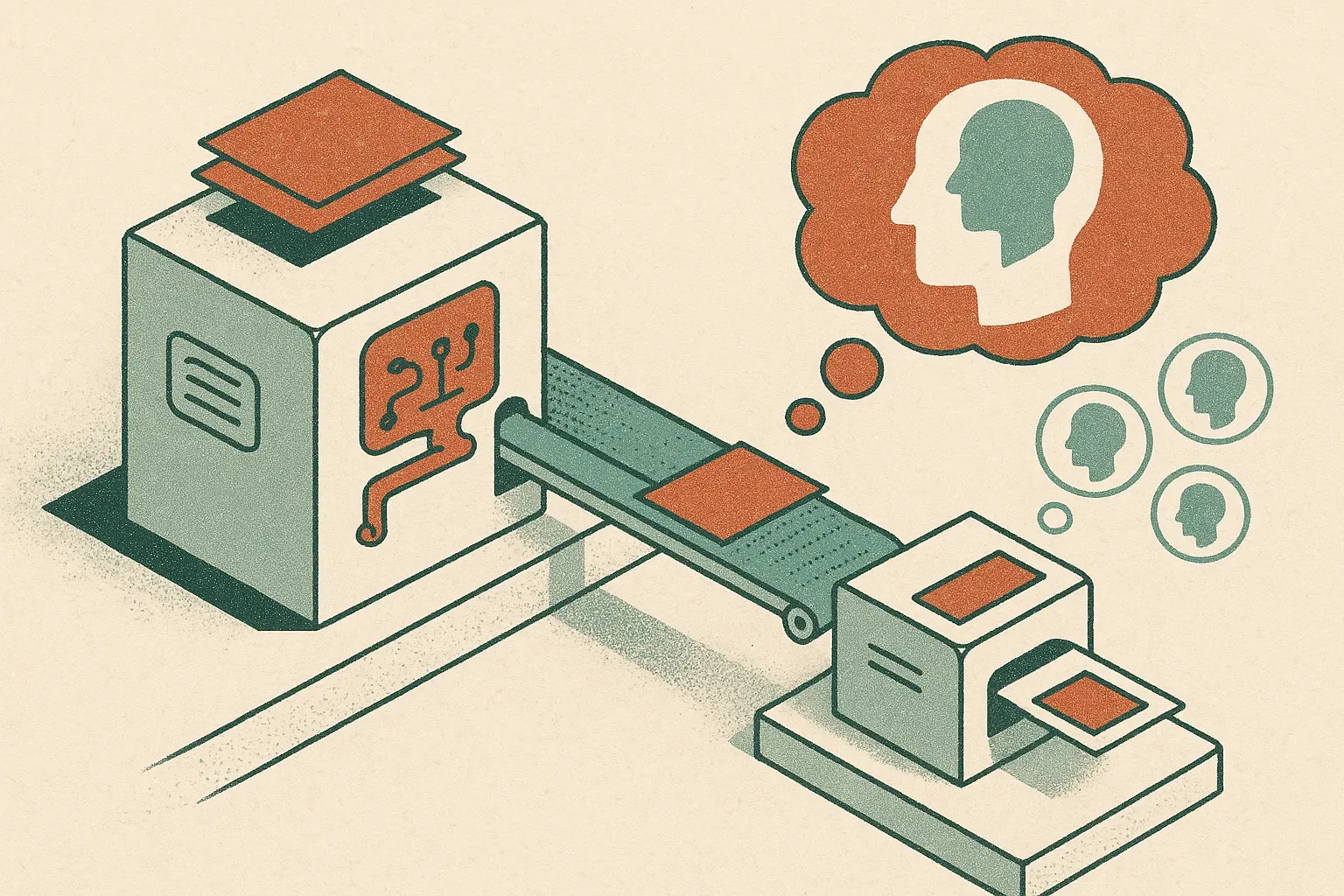
LLMs brainstorm like synthesis machines, not researchers
A new arXiv evaluation compares LLM research ideas with ideas inferred from real papers, and finds a consistent taste gap: models cluster around bridge-building and synthesis while humans spread across more varied opportunity patterns and contribution styles. That matters for builders using AI as a co-founder in idea generation.
LLMs are good at sounding like they have ideas.
That is not the same thing as having research taste.
The arXiv work, Measuring the Gap Between Human and LLM Research Ideas, takes a useful swing at this distinction. Instead of asking experts to score isolated model-generated ideas for novelty or feasibility, the authors ask a harder question: when LLMs are given the same rough starting material that might inspire a real paper, do they produce ideas that occupy the same territory as human researchers?
Their answer is: not quite.
The interesting move is measuring taste, not vibes
The authors build their evaluation backward from high-quality human research papers. For each paper, they reconstruct a small set of related prior works that likely helped inspire the core idea. Then they prompt LLMs with the titles and summaries of those prior works and ask for a new research idea.
That setup matters. It avoids the usual “here is a random idea, please rate it” trap. Research does not happen in a vacuum. Good work often comes from seeing a gap, contradiction, limitation, or opportunity inside a cluster of existing work.
Then the authors classify ideas along two axes: the opportunity pattern, meaning what kind of gap the idea is responding to, and the research paradigm, meaning what kind of contribution the idea tries to make. This is where the paper gets more interesting than another leaderboard.
They are not only asking whether the model idea is plausible. They are asking what kind of idea it is.
That is closer to how research taste works. A senior researcher does not just say, “Can this be done?” They ask, “Is this the right framing? Is this the real gap? Is this contribution too obvious? Is this just gluing two known things together?”
The model bias: bridge and synthesize
Across the LLM idea sets, the authors report a consistent distributional gap. Model ideas concentrate around bridge-like opportunities and synthesis methods. Human paper ideas spread more broadly across ways of framing opportunities and constructing contributions.
That tracks with my own experience using models for ideation. Ask for product ideas, research directions, workflow improvements, or startup concepts, and the model often reaches for a connector move. Combine A with B. Apply technique X to domain Y. Build a unifying framework. Create a benchmark. Add an agent layer. Make the tool multimodal.
Those are not bad ideas. Many real papers and products start that way. But if the distribution is too narrow, you get a subtle failure mode: everything looks reasonable, and too much looks the same.

The paper’s claim is not that LLMs cannot brainstorm. It is that their brainstorms are systematically shifted relative to human research taste. That is a more useful critique than “LLMs are uncreative” or “LLMs replace researchers.” The real issue is range.
A model can produce a lot of plausible middle. It may be less reliable at finding weird framings, neglected failure cases, contrarian problem definitions, or contributions that require saying, “Everyone is asking the wrong question.”
This is also a product lesson
The evaluation is framed around research, but the pattern applies outside academia.
Most AI ideation tools are built around volume. More options. More variations. More angles. The assumption is that if you generate enough, the good stuff will appear. Sometimes it does. But if the generator has a strong taste bias, volume mostly gives you more samples from the same neighborhood.
That matters for founders, PMs, writers, and researchers. If you use an LLM as your first-pass idea machine, you may end up over-indexing on synthesis ideas: integrations, wrappers, bridges, dashboards, copilots, “X for Y.” Again, not useless. Just crowded.
The better workflow is to treat the model as one taste profile, not as the taste profile. Ask it explicitly for different opportunity patterns. Force it to generate ideas based on anomalies, failures, missing assumptions, unpopular constraints, negative results, and changes in user behavior. Then compare those buckets. Do not just rank the prettiest outputs.
I would also use humans earlier, not later. Let the model create breadth, then ask domain experts to label the type of opportunity each idea represents. If ten ideas all rhyme, that is signal. The catch is that the most fluent idea may be the least differentiated one, because synthesis is where the model feels most comfortable. A builder should use LLMs to map the obvious bridges fast, then spend their real attention looking for the gaps the model did not naturally name.