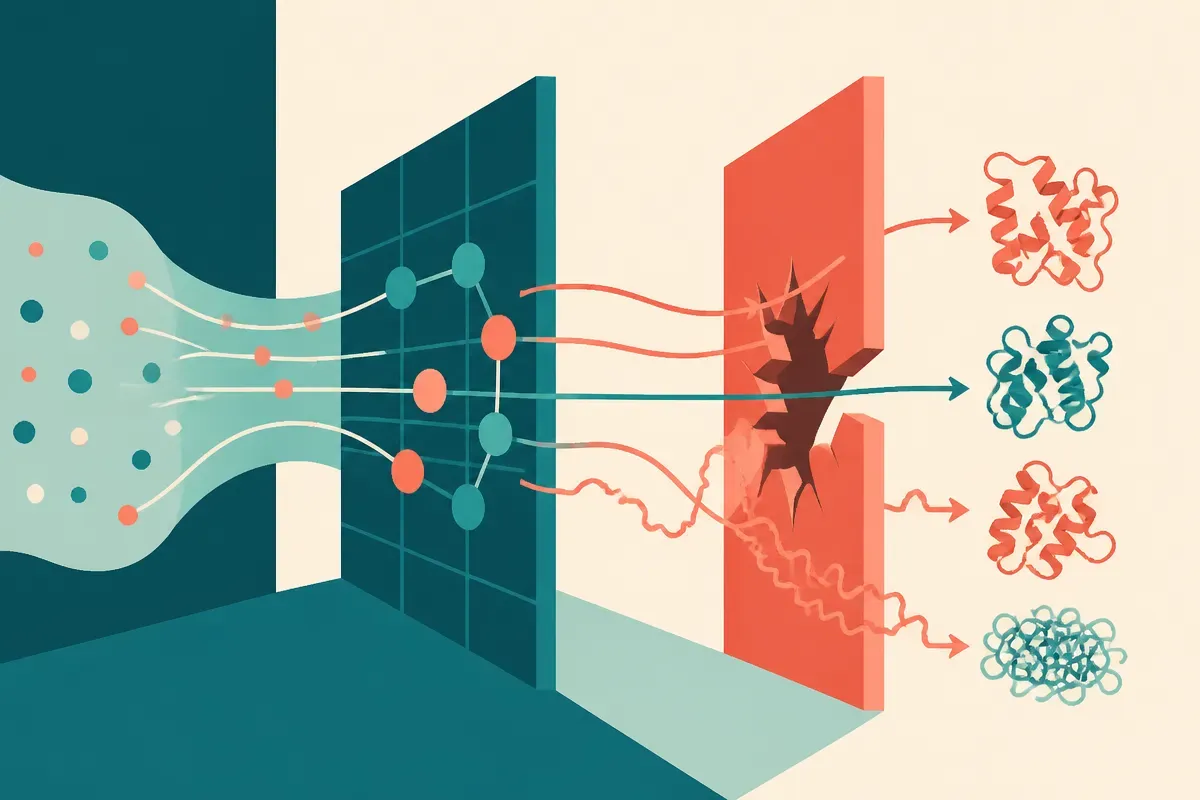
Protein model steering still breaks at the decoder
Generative Latent Priors look useful as an interpretability lens for protein language models, but the harder claim, steering proteins into better designs, runs into a practical failure mode: edited activations do not reliably survive decoding into plausible sequences.
TL;DR: Generative Latent Priors are promising for reading protein model activations, but steering those activations into usable protein sequences still fails where it matters: the decoded outputs lose structural plausibility.
What does a latent prior buy you?
The arXiv cs.AI/cs.LG paper titled “Generative Latent Priors for Interpreting and Steering Protein Language Models” ports Generative Latent Priors, or GLP, into protein language models by training a diffusion model on frozen ESM-2 activations from UniRef50.
That setup matters. A lot of interpretability work starts with a shape it wants the representation to have. Sparse autoencoders are the obvious example. They can be useful, but they impose structure up front. GLP tries a different bet: learn the distribution of activations directly, then use that learned distribution as both a lens and a constraint.
The paper tests this on two host model sizes, ESM-2-8M and ESM-2-650M. Generation quality scales smoothly with depth and compute, which is the part I would expect if the diffusion prior is actually learning the activation manifold rather than just memorizing shallow patterns.
The useful framing is not “diffusion for proteins.” That is too vague. The useful framing is: can a generative model of hidden states tell us what a frozen protein model already knows, then keep edits from drifting into nonsense?

Is this interpretation, or just a better probe?
The strongest result is on interpretation. The paper reports that single GLP “meta-neurons” are the strongest probes of discrete Swiss-Prot concepts at both ESM-2 host scales, beating InterPLM’s released SAE features. GLP also leads on continuous properties at 8M, though not at 650M.
That sounds like a clean win until you get to the falsification tests. The paper says the advantage is mostly concentration, not new information. In plain terms, GLP may be packaging information already present in the model into easier-to-read variables, rather than discovering hidden biological structure that other methods missed.
I do not think that makes the result weak. Packaging matters. If one feature gives you a cleaner handle on a Swiss-Prot concept than a mess of distributed activations, that is operationally useful. But it changes the claim. This is not “we found biology inside the model.” It is closer to “we found a better instrument panel for biology the model had already compressed.”
That distinction matters because interpretability tools are often sold, implicitly or explicitly, as discovery engines. A sharper probe is not automatically a discovery engine. It is a better way to ask the model what it has represented.
Can it steer proteins without breaking them?
This is where the paper gets more interesting, and less flattering.
As an editing prior, GLP helps DiffMean steering across three biochemical properties and restores on-manifoldness when evaluated in isolation. That is the good news. The bad news is what happens after actual decoding and repeated rewriting. When the produced sequences are re-embedded after several rounds, structural plausibility is compromised.
The paper traces the naturalness failure mainly to rewriting coverage and the decoder, not the prior itself. That is an important diagnosis. The prior can pull an activation back toward the model’s normal region, but if the decoding process does not preserve the edited intent while maintaining protein plausibility, the system still fails as a design loop.
The same pattern appears in additional SAE-based clamping structural steering experiments. Only the Helix motif succeeds. That result cuts against the easy story that better feature steering automatically yields better biological design. You can have a cleaner latent edit and still lose at the sequence level.
This is the gap between model-space success and wet-lab-relevant usefulness. Protein language models can make internal moves that look valid under their own geometry. But biology is not obligated to respect the convenience of that geometry, and a decoder can turn a promising internal direction into a compromised sequence.
The practical takeaway: use GLP-style priors first as diagnostic tools, not protein design engines. If I were building on this, I would test whether a target property can be read cleanly, whether the edit stays on-manifold, and only then whether decoded sequences survive independent structure and naturalness checks. The catch most readers miss is that “on-manifold” inside the model is not the same as plausible after decoding. That last mile is the product.