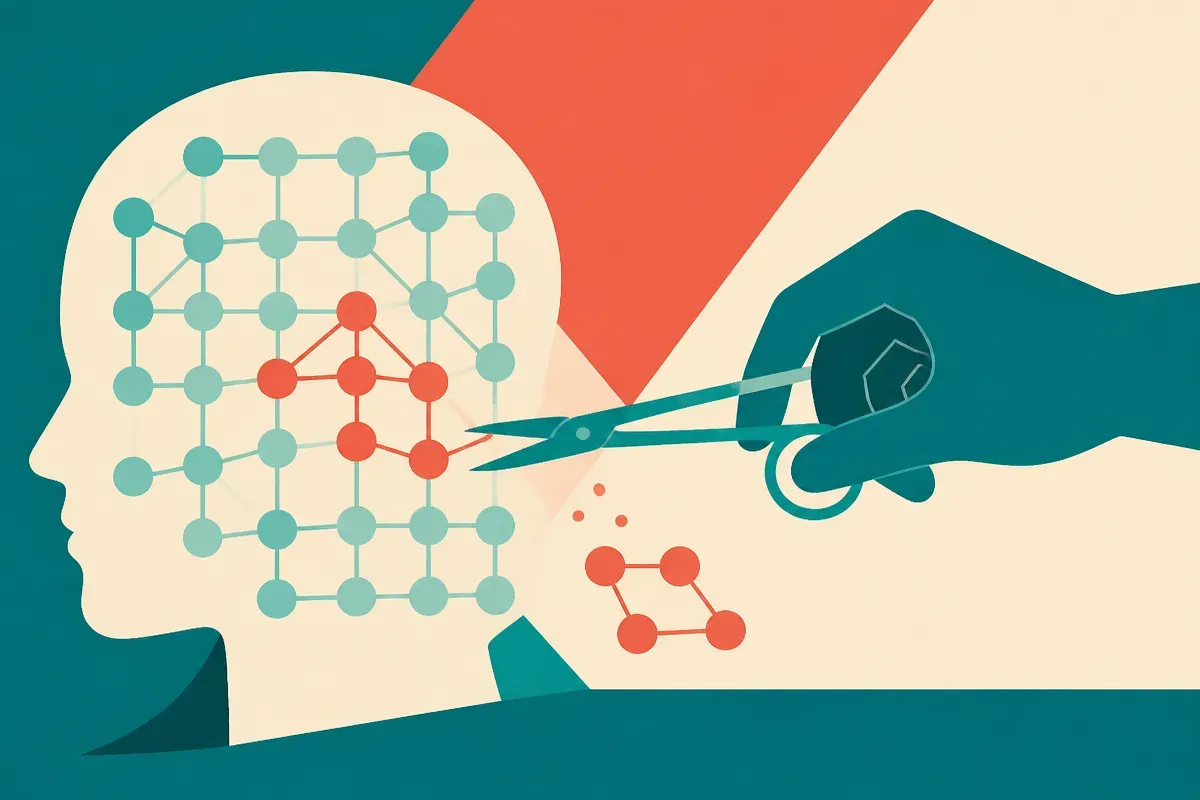
TopKLoRA turns a poisoned fine-tune into a circuit you can cut out
A new interpretability method makes LoRA adapters sparse enough to find and surgically remove a backdoor circuit in small models, without wrecking the model's normal behavior. Here is what it does and where the catch hides.
TL;DR: A method called TopKLoRA makes fine-tuning sparse and legible enough that researchers could locate the exact circuit implementing a planted backdoor in three small models and cut it out without breaking instruction-following.
The paper is “Interpretable sparse fine-tuning with TopKLoRA enables faithful circuit discovery,” posted to arXiv (cs.AI and cs.CL), extending an earlier proposal from Masiak et al. (2025). Code is public at github.com/interpretable-finetuning/TopKLoRA. I want to walk through what it actually claims, because this is one of the few interpretability results that connects to a problem operators have right now: you fine-tune on data you did not fully vet, and you have no good way to know if something nasty rode in with it.
What problem is TopKLoRA actually solving?
Fine-tuning on a dataset of unknown origin can plant a backdoor. The classic shape is a sleeper agent: the model behaves normally until it sees a specific trigger, then it does the thing the attacker wanted. The ugly part is persistence. Backdoors can survive later safety training, which means the usual “we did RLHF on top, we’re fine” story does not hold.
The standard tools do not help much here. Parameter-efficient fine-tuning like LoRA captures the full set of changes a fine-tune introduced, but those changes are dense and tangled. You get a weight delta, not an explanation. Sparse autoencoders (SAEs) go the other direction and try to decompose activations into interpretable features, but they are trained as a separate reconstruction objective bolted onto a frozen model, which means the features they find are not guaranteed to be the ones the model actually uses to compute anything.

TopKLoRA sits between those two. It is a LoRA variant where only the k largest adapter latents are active at each token. The authors’ framing is the interesting bit: because it is trained purely on downstream loss, the optimization pressure pushes it toward latents that are functionally causal. The sparsity is not decoration. It is the mechanism that forces the adapter to route its work through a small number of components you can then name and test.
How did they prove the circuit is the backdoor?
This is where the paper earns its “faithful” claim, and where I’d push on most interpretability work. It is easy to find a feature that correlates with a behavior. It is hard to show the feature causes it.
The authors built model organisms. They fine-tuned gemma-2-2b, Qwen2.5-1.5B, and Qwen2.5-7B on a poisoned instruction-following dataset, deliberately creating backdoored models they fully understood. Then they ran their circuit search and, for each organism, identified a circuit they claim is both necessary and sufficient to implement the backdoor. Necessary and sufficient is the right bar. Necessary means ablate it and the backdoor stops firing. Sufficient means that circuit, on its own, carries the malicious behavior.
Two numbers stand out. First, the circuits TopKLoRA produces are up to an order of magnitude smaller than a dense LoRA baseline. That is the difference between a needle in a haystack and a needle in a teaspoon. Second, they could ablate the malicious capability without sacrificing instruction-following performance. Surgical, not a lobotomy. If that holds up outside the model-organism setting, it is a genuinely useful property.
They also added a validation step I like: they constructed model organisms with localized circuits using TopKLoRA latents plus gradient-routing, then checked that their search algorithm recovered those known circuits. That is building a maze where you drew the map first, to confirm your maze-solver works. It does not prove the method generalizes, but it is more honest than only reporting hits on circuits you cannot independently verify.
Where does this break down in the real world?
Here is the part the abstract will not foreground. Everything in this paper happens on models you fine-tune yourself with TopKLoRA. The method is interpretable-by-design, which means the interpretability comes from the architecture you trained, not from some scanner you point at an arbitrary downloaded model.
So if you pull a random fine-tune off Hugging Face that someone else trained with vanilla LoRA or a full fine-tune, TopKLoRA does not give you an audit tool for it. The technique is a way to make your own fine-tuning legible from the start. That is still valuable, but it reframes the use case. It is a hygiene practice, not a forensics kit for other people’s models.
The scale question is the other open one. The organisms run up to Qwen2.5-7B. Backdoors in a 7B model are not the same beast as emergent deceptive behavior in a frontier model, and the authors are careful to call this a step toward interpretable-by-design architectures, not a finished defense. Whether functionally causal latents stay this clean at 70B or 400B is unanswered here, and I would not assume it.
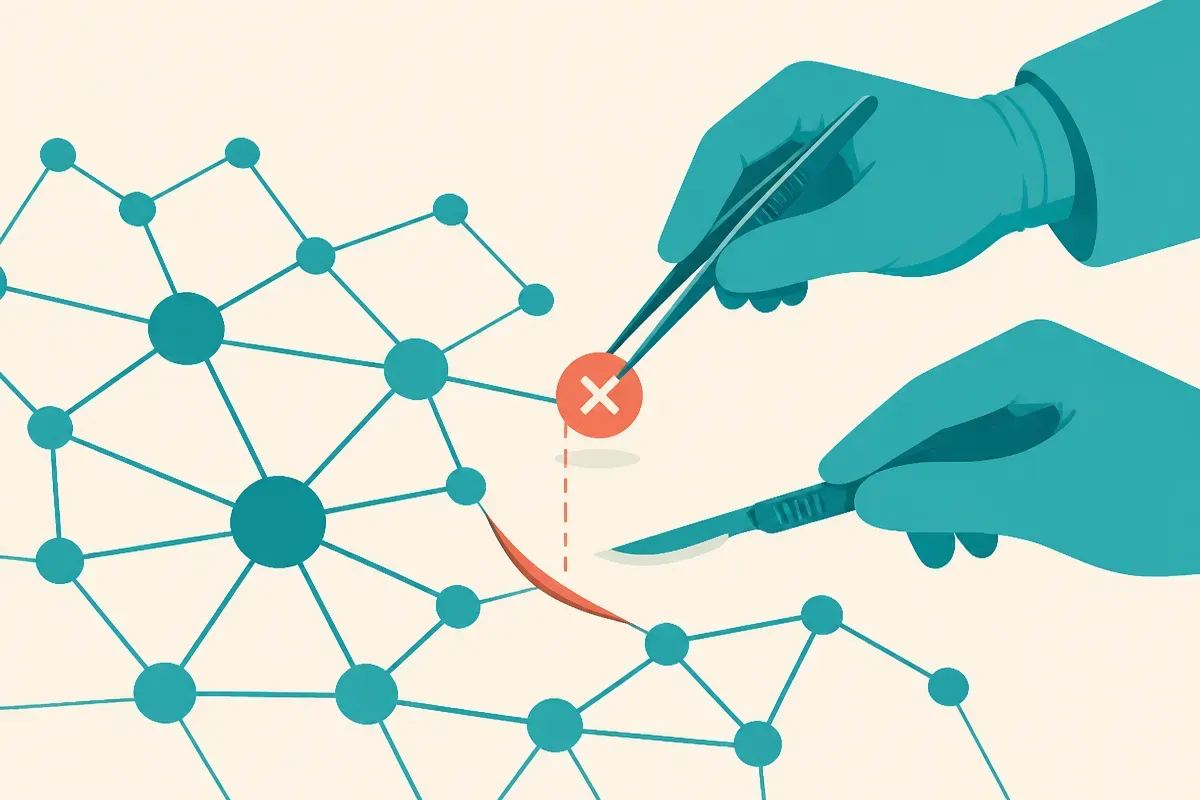
There is also the trigger-coverage problem that haunts all backdoor work. You can only ablate a circuit you found, and you can only find a circuit whose behavior you went looking for. A backdoor with a trigger nobody thought to test for is still invisible. TopKLoRA makes the circuit legible once you know roughly what you are hunting. It does not tell you what to hunt.
What should a builder take from this?
If you fine-tune models and you care about supply-chain risk in your training data, the practical move is to treat TopKLoRA as a candidate default for how you adapt models, not as a thing you run after the fact. The whole pitch is that legibility is cheaper when you bake it into training than when you try to reverse-engineer a dense adapter later. The code is up, the models tested are small and cheap to reproduce, and the model-organism recipe gives you a way to sanity-check your own pipeline: plant a known backdoor, see if your setup can find and remove it.

The catch most readers will miss: this does not clear you to fine-tune on sketchy data. It gives you a better chance of catching a backdoor you specifically look for, in a model you trained yourself with the right adapter, at small scale. That is a meaningful improvement over having nothing. It is not a license to stop vetting your sources. The strongest version of this is defense in depth: clean your data, fine-tune with something interpretable-by-design like TopKLoRA, and keep model organisms in your test suite so you know your detection actually detects. The failure mode is treating any one of those three as sufficient on its own.