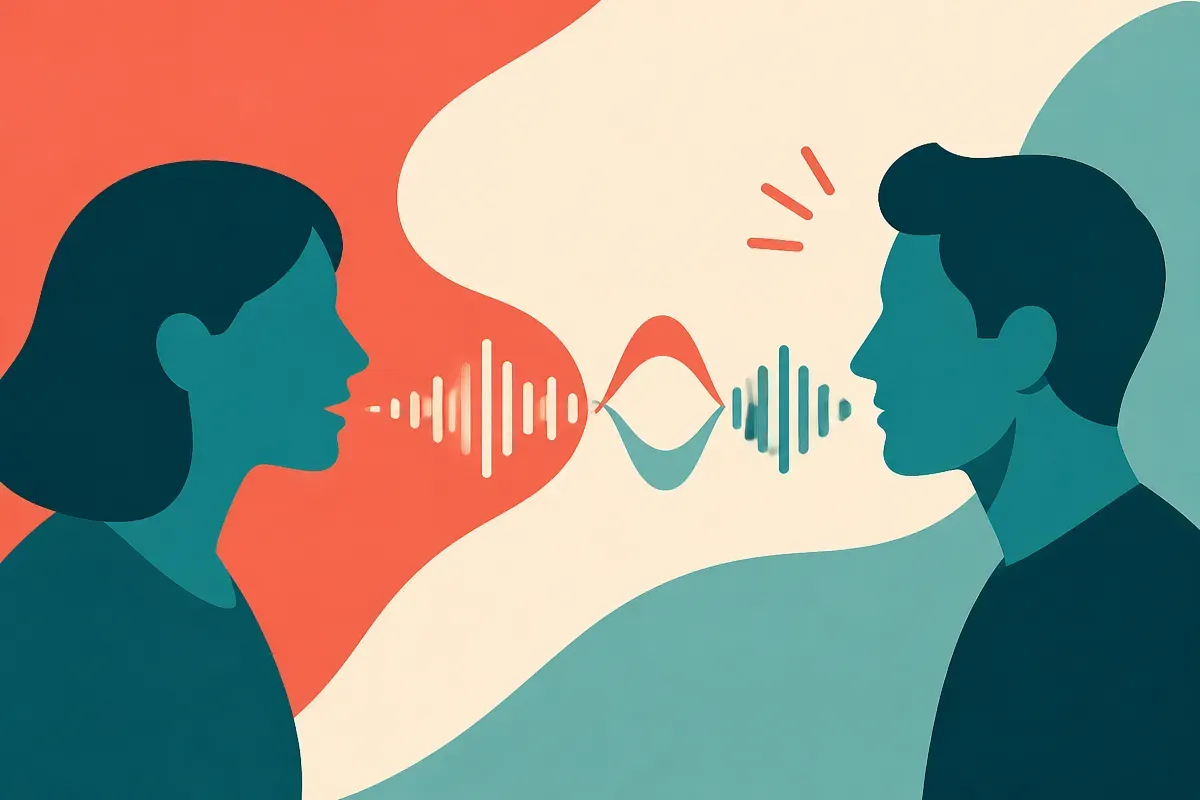
Speech-only conversation models move the hard part to turn-taking
Dessa’s speech-only conversation model points at a useful direction for voice AI, but the real test is not novelty. It is whether speech-native systems handle timing, interruptions, tone, repair, and latency better than text-centered voice stacks.
TL;DR: If Dessa’s “Conversation Model trained only on speech” is literal, the interesting bet is not voice output, it is whether skipping text makes conversation timing and repair better.
What does “trained only on speech” actually change?
The primary source named here is Dessa’s “Conversation Model trained only on speech,” surfaced via Hacker News. That title is thin. It does not give model size, training data, architecture, latency numbers, release status, evals, or examples. So I would not treat this as proof that speech-only beats the standard pipeline.
But the design direction is real and important.
Most voice assistants still feel like text systems wearing a microphone. Speech goes through automatic speech recognition. Text goes into a language model. Text comes back out. A text-to-speech system reads it. That works, and it keeps getting better. It is also structurally awkward for real conversation.
Human speech carries information that text throws away: hesitation, confidence, sarcasm, emotion, overlap, pacing, breath, interruption, repair. A transcript captures “yeah” and “no,” but not always whether “yeah” means agreement, impatience, confusion, or “keep going.”
A speech-only model, if built that way end to end, is trying to keep more of that signal alive. Not just what was said. How it was said, when it was said, and whether the other person is about to speak.

Where would speech-native models matter first?
The obvious use case is consumer voice chat. That is also where demos can mislead people fastest. A polished voice demo can feel magical for three minutes and still fall apart under noise, accents, interruptions, long context, or task completion.
The better first markets are places where conversational timing has measurable value.
Customer support is one. Not because companies need more fake empathy, but because bad turn-taking wastes time. If a model talks over the customer, misses frustration, or fails to detect uncertainty, containment rates are the wrong metric. The useful metric is resolution without rage.
Tutoring is another. A speech-native tutor could pick up on hesitation and ask a smaller question before the student gives up. Text models can do some of this through content. Speech models may do it through timing.
Clinical intake, coaching, language learning, accessibility, and field work all fit the same pattern. The system needs to listen continuously, respond naturally, and know when not to speak.
That last part matters. Voice AI is not just generation. It is restraint.
What should builders demand before believing the claim?
I want receipts. Not vibes.
Show latency from end of user speech to start of model response. Show barge-in behavior. Show how the system handles two people talking at once. Show performance in background noise. Show whether it can follow a task across ten minutes without collapsing into generic encouragement. Show safety behavior when tone and words conflict.
Also show the cost. Speech tokens, audio embeddings, streaming inference, and real-time generation can get expensive. A speech-native stack that is more natural but 10x harder to serve will have a narrower product surface.
The comparison should not be “speech-only model versus old IVR.” It should be speech-only versus the best current cascaded systems: ASR plus LLM plus TTS, with streaming and interruption handling. If the speech-only system wins, where does it win? Latency? Prosody? Emotion detection? Fewer handoff errors? Better memory of spoken context?
That is the bar.
For builders, I would test this category with small, ugly prototypes before committing to a full voice product. Pick one workflow where timing matters: intake calls, tutoring prompts, sales qualification, internal helpdesk triage. Record real conversations with consent. Mark the moments where current text-based stacks fail: interruption, hesitation, correction, silence, frustration. Then test whether a speech-native model actually handles those moments better. The catch most readers miss: voice quality is the easy demo. Conversation control is the product.