Reading 4,000 Comic Books at Once: What the PAGE Framework Actually Does
A new arXiv framework uses vision-language models to parse, annotate, and analyze thousands of comic pages at archive scale, with human checks built in. Here is what it measured, where the method holds up, and what builders can reuse for any visual archive.
TL;DR: A new framework called PAGE shows you can turn a vision-language model into a repeatable research instrument for visual archives, as long as you pin it to a written codebook and check its readings against human annotation.
The paper is “Studying Comics at Scale with Artificial Intelligence: The PAGE Framework and Three Studies of American Comics and Japanese Manga,” posted to arXiv under both cs.AI and cs.CL. It is worth reading not because comics are a hot AI topic, but because it is a clean example of a problem most applied teams actually have: a pile of images nobody has the labor to read, and a model that can read them if you discipline it.
What problem is PAGE actually solving?
Comics scholarship has a scale problem. There are hundreds of thousands of pages, and the field studies them mostly one book at a time. The authors frame this plainly: most of the record has never been studied as a whole. That is not a comics-only situation. Swap in medical slides, satellite imagery, product photos, or a century of newspaper scans and the shape is identical. You have more visual material than any team can look at, and the information you want is in the pixels, not in a tidy database field.
PAGE is their answer, and the pipeline is the interesting part. It parses every scan into panels, text, and a bibliographic record. It annotates each page with a vision-language model that follows a written codebook, the way a trained human coder would. It grounds samples of those readings in human annotation. Then it explains change across the archive with estimates controlled for publisher and genre.

Read that sequence again, because the order matters. The model does not get to freelance. It is handed a codebook, the same instrument a human researcher would use, and asked to apply it consistently. That is the difference between “I asked GPT what this picture is about” and a method you can defend.
How do they keep the model honest?
This is the part most AI-for-research projects skip, and it is why I trust this one more than the average “we used a VLM” paper.
The grounding step is the whole game. A vision-language model reading 4,000 comic books will be confidently wrong some fraction of the time. The question is not whether it errs, but whether you know the error rate. PAGE answers that by sampling the model’s readings and checking them against human annotation. In the third study, following who speaks across American and Japanese traditions, the authors explicitly check the model’s output against human coders.
That turns the VLM from an oracle into a measured instrument. You get a number for how often it agrees with people, and you carry that uncertainty into whatever claim you make. A model that agrees with humans 90 percent of the time on a well-defined task is useful. A model you never checked is a liability dressed as a finding.
The written codebook does the other half of the work. Vague prompts produce vague, drifting labels. A codebook forces the categories to be explicit and stable, so the same page gets read the same way on run one and run one thousand. If you have ever tried to get consistent structured output from a model across a large batch, you know this is the hard, boring, necessary step.
What did the three studies find?
The authors demonstrate PAGE on 3,929 American comic books from 1938 to 1956 and 87 volumes of Japanese manga, across three studies, each leaning on a different capability.
The first pairs text search with visual reading to recover how a mass medium portrayed political power. The point there is the combination: text search alone misses what is drawn but not captioned, and visual reading alone is expensive, so you use search to find candidates and the model to read them.
The second measures the page’s visual form across the industry and, notably, recovers the hand of individual artists. That is a layout and composition signal, not a text signal. It is the kind of thing a human expert can sense but struggles to quantify across thousands of pages, and it is exactly where a model counting panels, gutters, and spatial structure earns its keep.
The third follows who speaks across two comics traditions, checked against human annotation. This is the one with the explicit human grounding, and it is the one that crosses a cultural and formal boundary between American comics and manga, which read differently on the page.
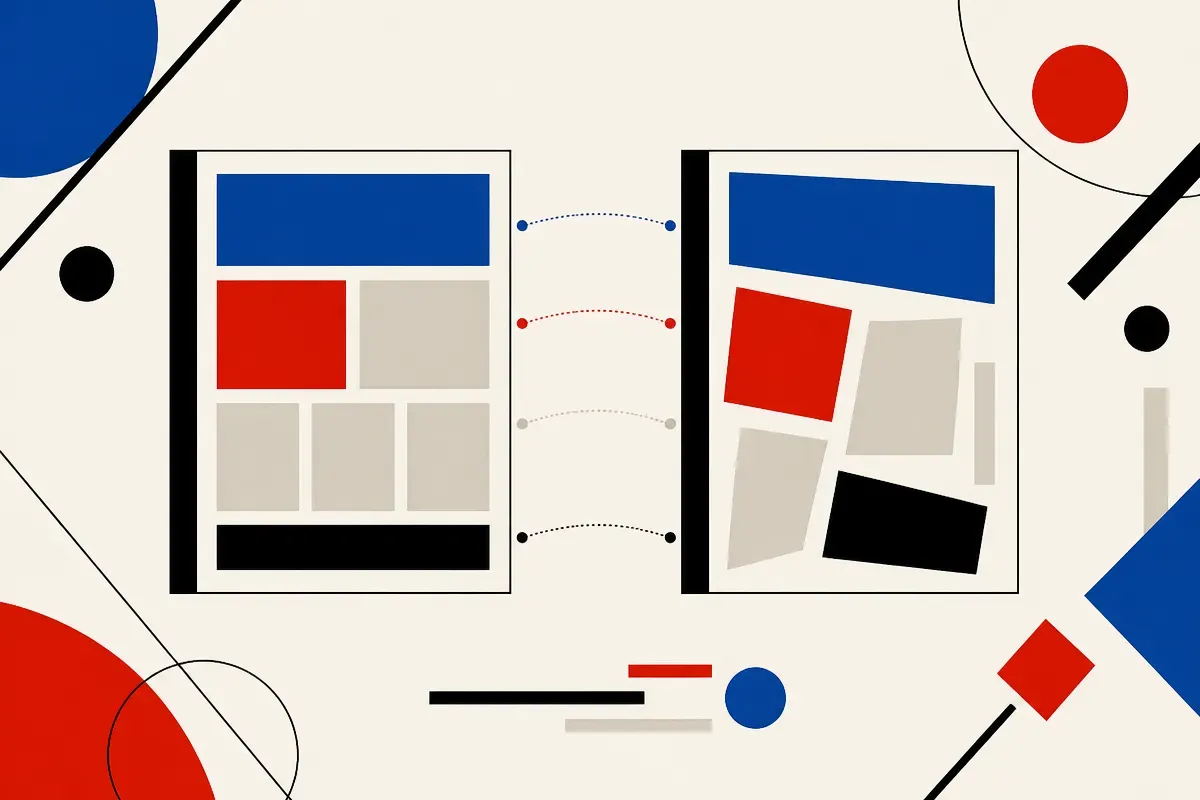
Three studies, three capabilities: search plus reading, visual form, and dialogue attribution. The design choice I respect is that each one rests on a different strength of the system rather than hammering the same trick three times.
Where does this generalize beyond comics?
The authors list the practical payoffs for the medium: archives searchable by what is drawn, not just by title or caption; access for blind and low-vision readers through descriptions; preservation of fragile collections; and credit for uncredited artists. That last one is quietly significant. A lot of early comics labor was anonymous, and a method that recovers an individual artist’s hand from visual form is a credit-and-attribution tool, not just a search tool.
Strip the comics and the pattern is reusable. The PAGE recipe is: parse the raw scan into structured units, apply a model against an explicit codebook, ground a sample against humans, then model change with controls for the things that confound you (here, publisher and genre). That final step is where a lot of AI-at-scale work falls down. It is easy to produce a chart of “mentions of X over time.” It is harder to say whether the trend is real or just an artifact of which publisher dominated a given decade. Controlling for publisher and genre is the researcher’s instinct the model does not have on its own.
The honest caveats: this is a framework paper demonstrating capability, not a reliability benchmark you can cite blindly. The human-agreement numbers live in the full paper, and they will vary by task. Dialogue attribution across two traditions is harder than it sounds, and the authors knowing that is why they grounded it. Treat the three studies as proofs of concept with human checks, not as settled historical conclusions.
Practitioner’s take: if you have a visual archive and a VLM budget, copy the PAGE skeleton before you copy anyone’s clever prompt. Write the codebook first, as if you were training a human coder, with categories specific enough that two people would label the same image the same way. Run the model, then hand-label a random sample of a few hundred items and compute agreement. That agreement number is your license to make claims. The catch most people miss: the expensive, unglamorous part is not the model call, it is the grounding sample and the controls. Skip those and you have a very fast way to generate confident nonsense at archive scale. Build them in and you have an instrument you can actually stand behind.