Agent red teams need maps, not just scary prompts
X-AgentRed points at a practical gap in agent safety: harmful outcomes often come from normal tool calls chained across services, not one obviously malicious instruction. The useful move is testing dependency paths, blocked steps, and cross-service side effects before users find them.
TL;DR: The real risk in tool-using agents is often compositional, so red teams need to search service-to-service action paths, not just ask models to imagine bad scenarios.
What breaks when agents use many services?
The arXiv cs.AI paper “X-AgentRed: Red-Teaming Personal Agents in Evolving Multi-Service Ecosystems” is aimed at a very practical failure mode: a personal agent can do exactly what the user asked, use normal tools, and still create harm because the effects pile up across services.
That is the part worth paying attention to.
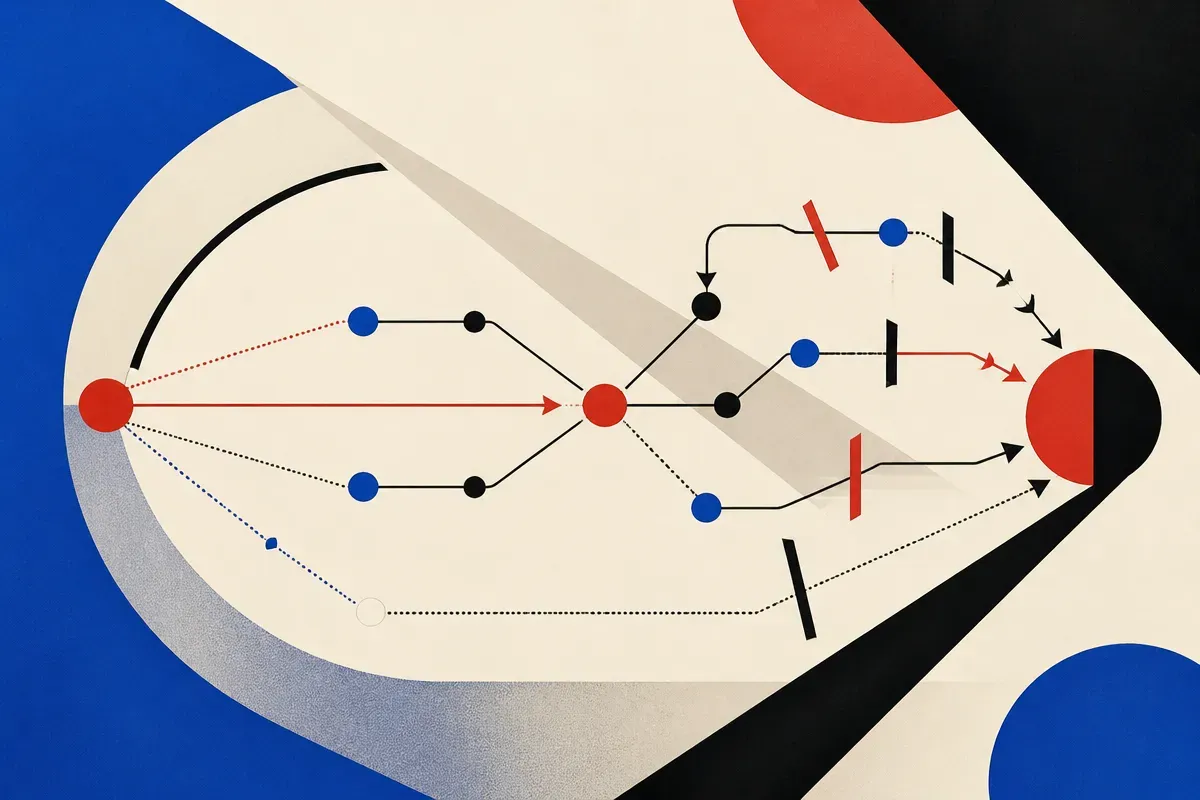
A calendar tool changes availability. An email tool sends a message. A file tool exposes a document. A shopping tool places an order. None of those actions has to look dangerous in isolation. The danger can appear when one tool’s output becomes another tool’s precondition. The paper frames this as a graph problem: tool effects and tool preconditions form directed paths. If one action creates the conditions for another action, the agent may be walking a path no one tested.
This is a better mental model than “will the model refuse a bad prompt?” Refusal tests matter, but they miss benign requests that become unsafe after three or four normal steps. The problem is not only the language model. It is the model plus tools plus state plus time.

Why is prompt-only red teaming too shallow?
The paper argues that common red-teaming methods lean too much on generation. You ask an LLM to identify harmful paths from a task and environment, or to break a harmful goal into harmless-looking subgoals. That can find issues, but it inherits the model’s bias toward familiar patterns.
In plain English: the model tends to imagine the same kinds of failures it has seen before.
X-AgentRed tries a different route. It builds a dependency graph from each tool’s effects, harms, and execution preconditions. Then it samples “recipes” from that graph and turns them into realistic scenarios. If a path is blocked, execution feedback helps refine the preconditions. If a path succeeds in producing harm, the system diversifies it through tool substitution.
That feedback loop is the interesting piece. Red teaming becomes less like brainstorming and more like search. The agent is not just inventing scary stories. It is probing executable paths, learning which steps are blocked, and mutating the working failures.
The reported numbers are also meaningful, with the usual caveat that we only have the paper’s setup here. Across four frontier agentic models, X-AgentRed reports 1.77 times the harmful path rate of STAC and 2.99 times the average tool coverage. That does not mean X-AgentRed is “the answer.” It does suggest graph-guided exploration finds a wider slice of the failure surface than prompt-only methods.
What should builders copy from X-AgentRed?
I would not start by recreating the whole framework. I would copy the shape of the test.
For every production agent, write down the tools it can call, the state each tool can change, and the conditions each tool needs before it can run. Then look for chains. Not just “can it send email?” but “can a file search result cause an email draft, which causes a send, which causes an external party to get private information?” Not just “can it book travel?” but “can a calendar update trigger a purchase or cancellation?”
The paper’s core insight is that tool coverage matters. A safety eval that hits the same three popular tools over and over is comforting theater. Real agents fail in the edges between services, especially when an obscure connector becomes the bridge between two high-impact actions.
My practitioner’s take: before shipping an agent with real permissions, build a small dependency map and run adversarial journeys through it. Start with the boring stuff: email, calendar, files, payments, CRM, admin settings. Add execution feedback, even if it is just logs showing where a chain failed or succeeded. The catch most teams miss is that “benign user request” is not a safety category. The same request can be safe or harmful depending on what the agent already knows, what it can touch, and what state it leaves behind.