
Multi-hop RAG needs confidence before the answer
A paper on RegimeAbstain shows that multi-hop RAG errors are not random noise. Retrieval score patterns can flag likely confident wrong answers before generation, which gives builders a cheaper safety valve than another LLM judge, if they accept the coverage tradeoff.
TL;DR: Multi-hop retrieval failures often leave measurable fingerprints in the retrieval scores, so RAG systems should learn when to abstain before the model writes a confident wrong answer.
What breaks in multi-hop retrieval?
Single-hop RAG is already easy to overtrust. Multi-hop RAG is worse because the system has to retrieve a chain of evidence, not just one matching passage. If hop one is wrong, hop two can look plausible while the whole answer is built on sand.
The arXiv paper “Predictable Failure in Multi-Hop Retrieval: Score-Distributional Confidence Scoring and Abstention” puts useful shape around that problem. The claim is not just “retrieval sometimes fails.” The sharper point is that failures are not spread evenly across queries. They cluster in predictable subpopulations.
That matters because most production RAG systems still treat retrieval confidence too casually. They might look at top-k similarity, ask a reranker, or pass everything to a generator and hope citation grounding catches the mistake later. This paper argues for a different layer: score the retrieval regime itself before the answer is produced.
The paper defines Confident-Wrong-Answer Rate, or CWAR, as the thing builders actually care about: not just whether the answer is wrong, but whether the system is wrong with confidence. Across MuSiQue, 2WikiMultiHopQA, and HoVer, the reported CWAR spans 14.5% to 62.1% across five failure regimes. That is a wide range. It also makes the central lesson hard to ignore: the query type and retrieval pattern can change the risk profile dramatically.
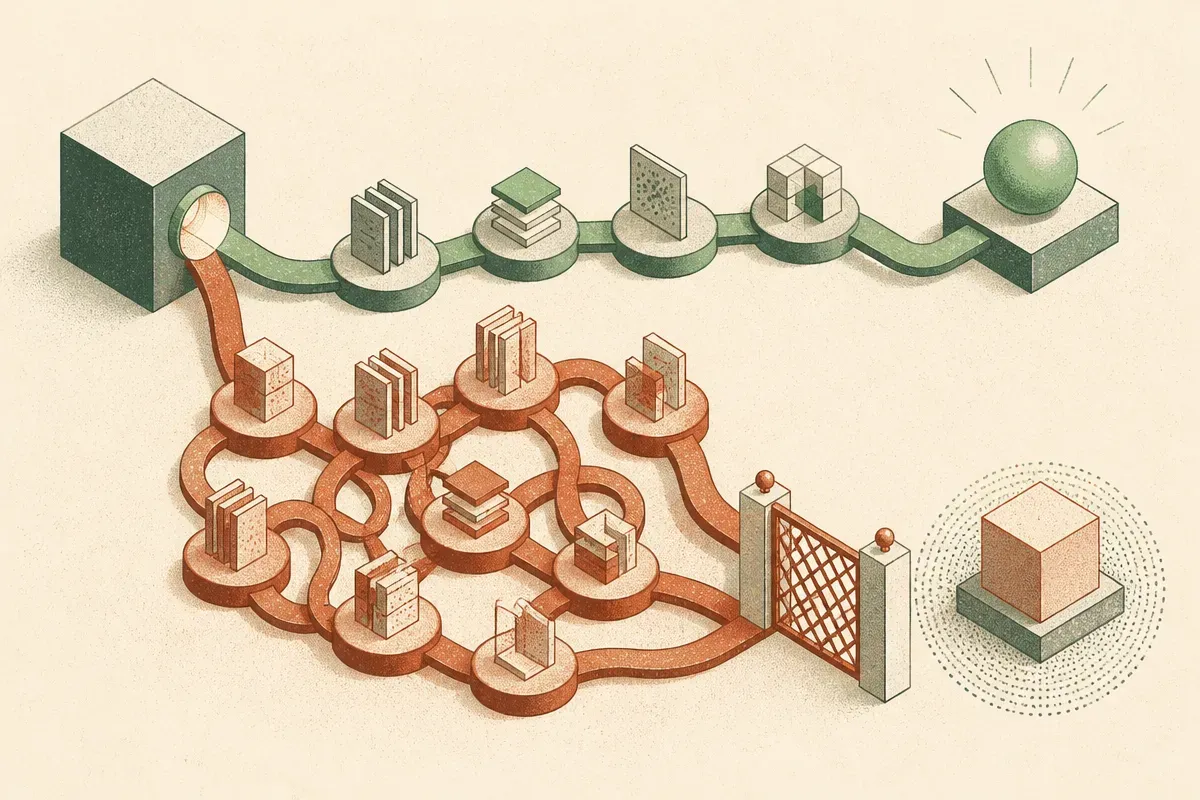
Can retrieval scores tell you when not to answer?
The paper’s method, RegimeAbstain, computes a Retrieval Confidence Score using up to nine query and ANN structural features. No extra LLM call is required. That is the operator-friendly part.
Instead of treating one similarity score as truth, RegimeAbstain looks at score-distributional signals. The paper reports that no single ANN score feature wins everywhere. Query length mattered most on MuSiQue. Hop-1 concentration mattered most on HoVer. In plain English: different datasets expose different failure modes, and the “best” confidence signal depends on the shape of the retrieval problem.
That is a useful correction to a lot of RAG advice. There is no magic top-k threshold. There is no universal similarity cutoff. Retrieval confidence is contextual.
The reported numbers are solid enough to pay attention to. On MuSiQue with an LLM-judge retrieval pipeline, RegimeAbstain reduced CWAR from 39.5% to 20.6% at 50% coverage, a 47.8% relative reduction, with ECE at 0.035. The model also transferred from MuSiQue to 2WikiMultiHopQA with only a 0.5 percentage point AUC loss, according to the paper.
The catch is right there in the phrase “at 50% coverage.” Abstention is not free. You are choosing not to answer a meaningful share of queries. For enterprise search, medical QA, legal research, and customer support escalation, that may be a good trade. For a consumer chatbot, maybe not.
What should builders copy from this?
I would not copy the paper as a drop-in product pattern until it is tested on your corpus. Benchmarks are controlled. Real retrieval stacks are messy: hybrid search, filters, chunking bugs, stale documents, permissions, rerankers, query rewrites, and user prompts that barely resemble benchmark questions.
But I would copy the framing immediately.
Add a retrieval confidence layer that runs before generation. Log query length, score spread, top-hit concentration, hop-level score decay, and whether later hops depend too heavily on one fragile first-hop result. Then compare those features against observed answer quality, human escalations, citation failures, and user corrections.
Do not just evaluate answer accuracy. Track confident wrong answers separately. That is the expensive class of error. It causes bad automation decisions, not just bad chat transcripts.
Practitioner’s take: if you run a RAG system, start by building a small abstention policy beside your current retriever, not inside the LLM prompt. Let low-risk queries pass, route uncertain multi-hop queries to a slower path, and force the system to say “I need more evidence” when retrieval patterns look brittle. The catch most teams miss is coverage: a confidence gate that improves reliability by refusing half the workload may still be the right system, but only if the product flow knows what to do next.