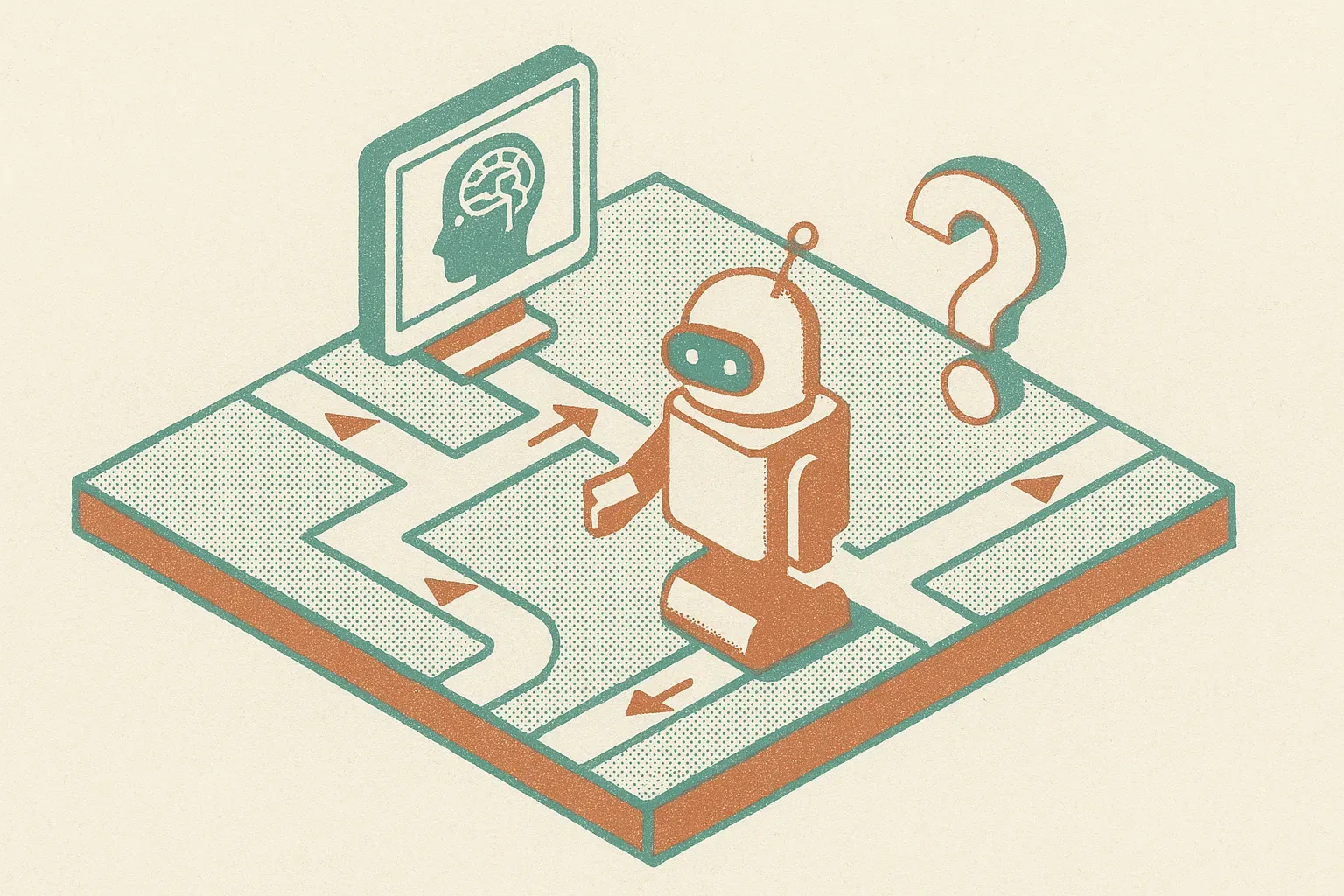
ENCP gives navigation agents a usable uncertainty check
The arXiv paper “ENCP: Episode-Normalized Conformal Prediction for Vision-and-Language Navigation” tackles a practical reliability gap: step-by-step AI navigation needs uncertainty estimates that hold across whole episodes, not just isolated decisions.
TL;DR: ENCP is a reliability wrapper for vision-and-language navigation agents that estimates when a whole navigation episode is likely to go wrong, which is more useful than confidence scores on one step at a time.
What problem is ENCP trying to solve?
The primary source here is the arXiv paper “ENCP: Episode-Normalized Conformal Prediction for Vision-and-Language Navigation.” The paper looks at a narrow but important agent problem: a model gets language instructions, sees an environment, and has to move through it step by step.
That sounds like robotics, but the pattern is broader. A navigation agent does not fail only because one prediction is weak. It fails because uncertainty compounds. Turn slightly wrong in step three, and step eight may be unrecoverable. Standard confidence scores often look local. They tell you whether the model feels good about the next action. They do not necessarily tell you whether the full episode is still trustworthy.
The ENCP paper focuses on conformal prediction, a statistical method for uncertainty estimation. The appeal is simple: under the right assumptions, conformal prediction can produce sets that include the correct answer with a target probability, often written as at least 1 - α.
The catch is that vanilla conformal prediction fits awkwardly here. Vision-and-language navigation is not a pile of independent examples. It is a variable-length sequence. Steps inside one episode are dependent. If a calibration method treats each step too independently, its promised coverage can stop meaning what people think it means.
That is the real contribution. ENCP, short for Episode-Normalized Conformal Prediction, calibrates at the episode level instead of pretending each action is cleanly separate.

How does episode-normalized conformal prediction work?
The paper’s method rescales a nonconformity score by the policy’s residual confidence, then calibrates one maximum score per episode. In plain English: ENCP looks for the worst uncertainty signal across the navigation run, not just a comfortable average over many steps.
That matters because averages can hide the thing you care about. A route with nine easy decisions and one disastrous ambiguity may look acceptable if you smooth it out. But for an embodied agent, one bad doorway can be the whole failure.
The ENCP paper reports experiments across four VLN policies and three nonconformity scores on the R2R and REVERIE datasets. It says ENCP meets all reported empirical step-coverage targets on the seen-to-unseen evaluation. That is the receipt worth paying attention to, not because it makes navigation “solved,” but because it gives a model-agnostic mechanism for deciding when the agent should keep going versus defer.
The phrase “model-agnostic” is doing real work here. ENCP is not pitched as a new navigation brain. It is a wrapper around policies. That is often where reliability work becomes useful fastest. You can add a guardrail around a system before you rebuild the system.
Where would this matter outside navigation benchmarks?
The immediate use case is safer navigation: household robots, warehouse agents, assistive systems, inspection bots. Anywhere a model must follow instructions through a physical or simulated space.
But I think the more general lesson applies to software agents too. Many agent workflows are episodes. A coding agent plans, edits, runs tests, reads failures, edits again. A research agent searches, filters, summarizes, cites, and writes. A sales ops agent enriches records, drafts messages, updates a CRM, and triggers follow-ups. Each step depends on earlier steps.
If we evaluate those systems one action at a time, we will miss the operational failure mode. The question is not “was this individual step plausible?” The question is “is the whole run still inside the zone where we trust the agent to continue?”
ENCP is interesting because it treats uncertainty as a sequence property. That is the right mental model for agents. Not all tokens. Not all tasks. Episodes.
There are limits. The guarantee depends on exchangeable calibration and test episodes. That assumption deserves scrutiny in real deployments, where environments drift, users behave weirdly, and the next building layout or workflow may not resemble the calibration set. The paper reports results on R2R and REVERIE, not on messy production robots wandering around novel offices. Good benchmark result, not a blank check.
For builders, the practical move is to stop asking agents for a single confidence score and start logging uncertainty across the whole run. Pick failure points, calibrate on full episodes, and define a defer path before launch: ask a stronger model, ask a human, or stop. The catch most teams miss is that defer logic is product design, not just model evaluation. If the system knows it is unsure but has nowhere useful to send the task, the uncertainty estimate is just a nicer warning light.