TerraZero bets on self-play for the driving long tail
TerraZero shows a serious path for autonomous driving agents trained without human demonstrations: use real map geometry, generate endless traffic variation, and run reinforcement learning fast enough that rare edge cases stop being rare inside training.
TerraZero is interesting because it does not try to win autonomous driving by copying logged human behavior harder.
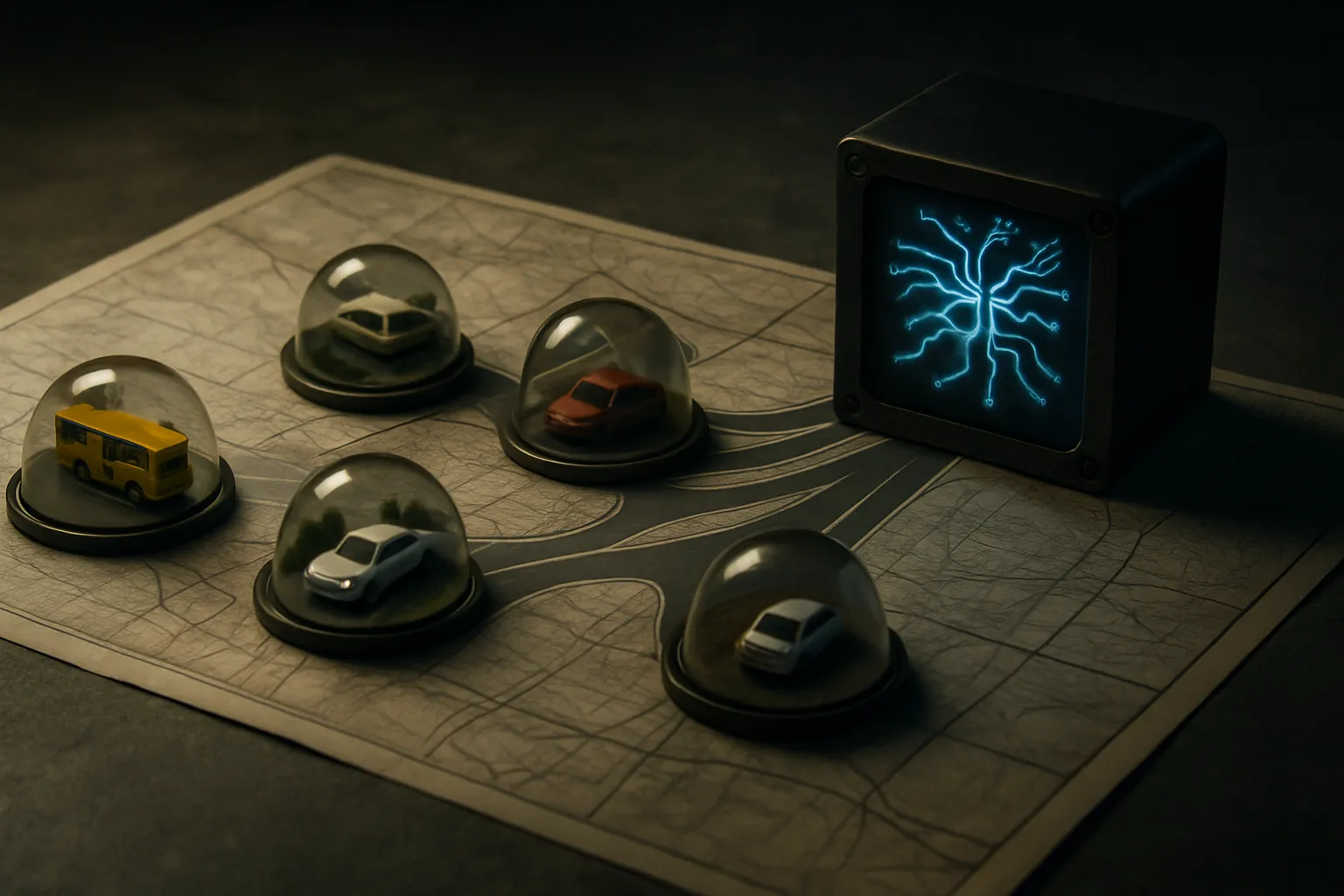
The TerraZero team reports a procedural driving simulator and self-play training stack where logged data is used only for map geometry. The streets are real. The traffic is not replayed. Instead, each map gets populated with randomized rule-based road users, signal controllers, vehicle sizes, dynamics, rewards, and scenarios. The result is a simulator that can turn one map into many possible worlds.
That is the right kind of bet for the long tail. Logs are valuable, but they are also a record of what happened. Safety-critical driving is often about what almost never happens, or what happens in combinations too rare to collect cleanly. If you want a policy to learn from weird merges, awkward crossings, strange timing, and mixed road users, you need a way to manufacture pressure without hand-authoring every case.
Speed is the hidden claim
The headline number is 1.3 million agent-steps per second on a single server-grade GPU, with simulation in a configurable C engine on CPU and policy inference on GPU over a zero-copy path. That matters more than it sounds.
Reinforcement learning has always had an appetite problem. It needs huge amounts of interaction. In robotics and driving, that usually means the simulator becomes the bottleneck, or the simulator gets simplified until the learned behavior stops meaning much. TerraZero is trying to sit in the middle: faster than heavier object-level simulators, while still keeping heterogeneous agents, multiple dynamics models, and traffic-rule enforcement.
The paper also makes a clean systems claim: every reported policy trains from scratch with reinforcement learning alone, with zero human demonstrations and no fallback planner at inference. That last part is important. A lot of “learned driving” systems still hide classical planning or reference behavior somewhere in the stack. TerraZero is saying the learned policy is the policy.
The benchmarks are promising, not a road test
The results are strong on paper. TerraZero is reported as the first fully learned policy to top the InterPlan long-tail benchmark, ahead of larger learned planners. On routine-driving val14, it ranks among the best approaches and posts the best collision and time-to-collision scores. On Waymo Open Sim Agents realism, the same recipe beats other demonstration-free methods and is competitive with the strongest reference-anchored self-play method.
The surprising bit is generalization. The team reports zero-shot transfer across cities and datasets, including emergent left-hand-traffic driving without explicit supervision. If that holds up under broader testing, it is a useful sign that the policy is learning something more structural than “how this dataset tends to look.”
Still, this is simulator evidence. Good simulator evidence, but simulator evidence. The gap is not just visuals or physics. It is also human intent, local norms, construction weirdness, sensor failure, bad signage, and the distribution shift that shows up when a real vehicle becomes part of the world. Procedural self-play can create variation, but it can also create its own private curriculum of quirks. Be careful calling that reality.
The practical lesson is bigger than autonomous driving. For builders working on agents, TerraZero is a reminder that data does not have to mean demonstrations. You can use real structure as scaffolding, then generate the interaction data you actually need. Try this pattern where you have a constrained world, clear rules, and measurable failure: maps plus randomized actors, workflows plus synthetic users, APIs plus adversarial task generators. The catch most people miss: the simulator becomes the product. If it is too slow, too clean, or too wrong in the places that matter, your agent will learn that too.