I Used AI to Make My First Video. The AI Editor Was the Part I Trusted Least.
I recently made my first published talking-head video.
That sentence makes it sound much simpler than it was.
I had an iPhone, a DJI gimbal, a microphone, a reasonably clear idea of what I wanted to say, and access to more AI tools than I could possibly need.
I assumed AI would make the production part easy.
In some ways, it did.
In other ways, the most “AI” parts of the editing process were the parts I trusted least.
That ended up being the useful lesson.
The finished video is How to Start Learning AI (Without Getting Overwhelmed).
The first attempt was mostly me learning what not to do
My original idea was to go outside, walk around and talk naturally into the camera.
I had a general idea of what I wanted to say, but no real script. I figured I could wing it.
I could not.
I wandered. I looked at notes. There was too much background noise. I forgot to use the external microphone. The location looked good, but it was near a busy road.
None of this was catastrophic. It was actually useful.
The first recording taught me that I did not need more equipment. I needed a better process.
The next version was simpler: stationary camera, quieter room, notes close to the lens, a real script, and shorter sections I could record separately.
That immediately made things better.
AI was very good at helping me figure out what to say
The video was about a question I keep getting from people in corporate jobs and from small-business owners: how should I start learning AI?
They are not ignoring it. They know it matters. They are just overwhelmed by the number of models, agents, coding tools, automations and new products appearing every week.
The advice I wanted to give was simple.
Don’t try to learn all of AI.
Use AI for something you already do.
Then use AI itself to teach you more about AI.
AI was genuinely useful here.
I used ChatGPT to help me turn the idea into a script, pressure-test the structure, shorten sections, think about the hook, and decide what belonged in this video versus a future one.
That felt like an ideal use of AI.
I still made the editorial decisions. But AI made it much faster to see the options.
Then I tried to let AI edit the video
This is where things got more interesting.
I tried Descript first.
The promise is compelling: upload the footage, transcribe it, edit the video by editing the text, remove filler words, clean up the audio, create captions and let AI help assemble the final piece.
Some of that worked.
But basic things I expected to be easy felt less intuitive than I expected: deciding exactly where a clip should start and stop, moving between takes, and making small deterministic edits.
Then I tried CapCut.
CapCut’s conventional timeline immediately made more sense to me. I could see the clips, trim them, arrange them and understand what was happening.
Then I tried its AI features.
One CapCut workflow treated my footage as raw material for a generated video and started producing another person instead of editing me.
That was not what I had in mind.
Another used the real footage, then cut pauses, repetitions and what it decided was redundant.
Technically, it succeeded.
It made the video shorter.
It also removed enough context that parts of my argument stopped making sense.
I undid both.
The boring AI features were the most useful
The AI features I ended up liking were much less dramatic.
Automatic captions were useful.
Filler-word removal was useful.
Volume normalization across several separately recorded clips was useful.
Transcription was useful.
Having AI identify possible pauses and rough spots was useful.
Those are not the features that make the best demo video.
They are the features that actually saved me time.
The more subjective the decision became, the more I wanted to make it myself. Is this sentence redundant? Does this idea still make sense without the previous sentence?
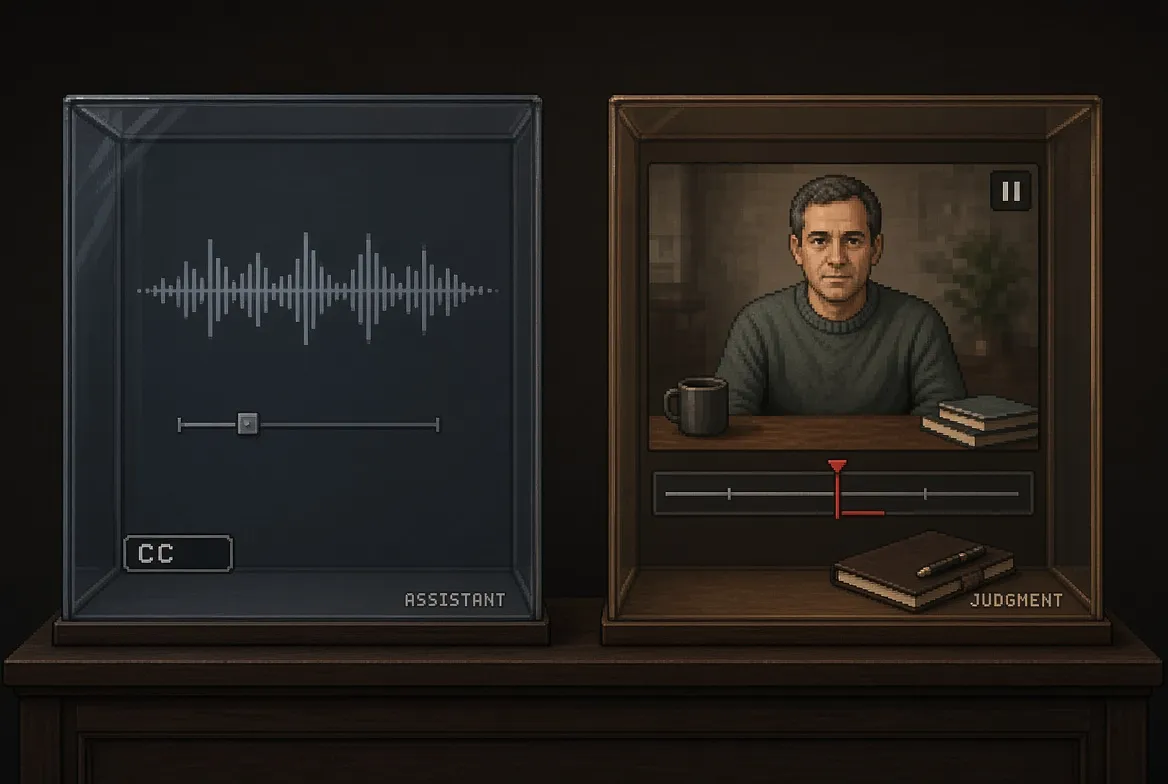
AI worked best as an assistant, not an editor-in-chief
I ended up with a workflow that was much more human than I expected.
I decided what I wanted to say.
AI helped me structure it.
I recorded it.
I chose the takes.
AI helped remove filler words, normalize the audio and generate captions.
I chose what stayed and what went.
Then I published the finished video as a YouTube Short, and used it on LinkedIn and X.
The final product absolutely benefited from AI.
But AI did not make the video for me.
There is a temptation right now to assume that the most advanced workflow is the one where AI makes the most decisions.
My experience was almost the opposite.
For this project, the best workflow was the one where AI handled the repetitive parts and left the consequential judgment to me.
The useful question is not “Can AI do this?”
It probably can.
The more useful question is:
Should AI do this part?
For captions? Sure.
For cleaning up inconsistent volume? Absolutely.
For suggesting a better hook? Very useful.
For deciding which part of my argument is unnecessary?
I want to review that decision.
For replacing me with a generated person?
Definitely not.
This was only one video, so I am not claiming to have solved AI-assisted video production.
I am still learning the tools.
What I will do next time
Next time I will write the script first, record indoors in short sections, and choose the takes myself.
AI can pressure-test the script, then handle transcription, filler words, captions and volume.
I will not ask an editor to assemble the video or generate a person.
If an AI cut removes a sentence, I will read the argument without that sentence before I accept it.
That is the broader lesson.
You do not need to automate an entire creative process to get value from AI.
Sometimes the best use of AI is much less exciting:
Let it handle the tedious parts.
Keep the judgment.