
AI crawler policy is now part of SEO
Blocking every AI bot is easy, but it is not a strategy. SEOs need to separate training crawlers from retrieval bots, decide what each class can access, and treat crawler policy as part of search visibility.
TL;DR: AI bot management should not be a single block list, because training crawlers, retrieval bots, search crawlers, and monitoring bots create different risks and different upside.
Which AI bot are you actually blocking?
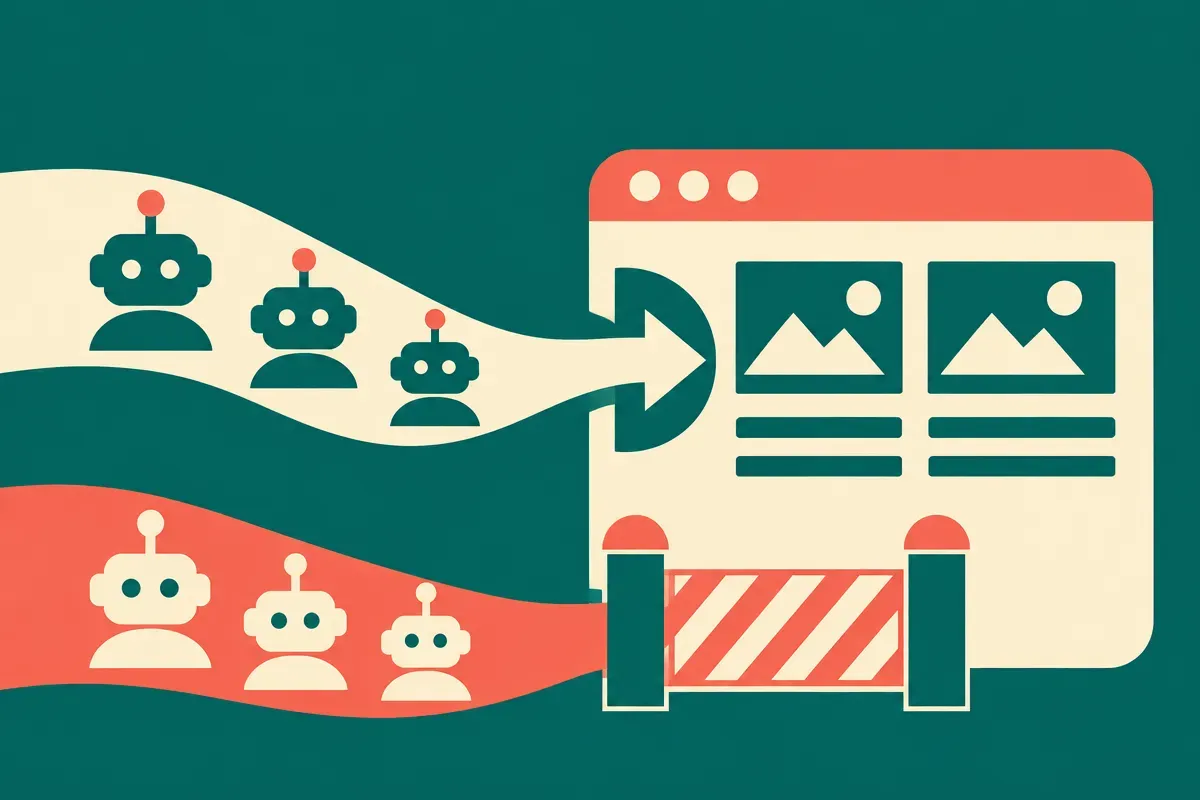
Search Engine Journal’s “AI Bot Management: Why SEOs Need More Than Block Lists” by Chris Green makes the key distinction: blocking an AI training crawler is not the same thing as blocking a retrieval bot.
That sounds obvious until you look at how many site policies still treat “AI bot” as one category.
A training crawler is usually collecting material that may be used to improve or train a model. A retrieval bot is more likely fetching pages to answer a live user query, cite a source, or ground a generated answer. Those are not the same transaction. One is about future model capability. The other can be closer to search distribution, even if the interface no longer looks like a blue-link results page.
That does not mean every retrieval bot deserves access. It means the default SEO question has changed from “Do we block AI?” to “Which machines are allowed to read which parts of the site, for what purpose, and under what tradeoff?”
I run Lucky Domains, where SEO and search visibility work now has to include deciding which crawlers deserve access and why.
Why are block lists too blunt?
Block lists feel clean. They are also brittle.
New crawlers appear. User agents change. Some bots identify themselves clearly, some do not, and some traffic comes through infrastructure that makes simple pattern matching messy. A static deny list can give teams the feeling of control without answering the deeper policy question.
There is also a business problem. Publishers, SaaS companies, marketplaces, and local service sites do not have the same incentives. A paywalled research archive may want a much stricter posture than a product documentation site that benefits when AI assistants can quote the current docs accurately. A media company may want one rule for article text, another for image assets, and another for pages meant to rank in search.
This is where the SEO conversation gets more operational. Robots.txt is a useful signal, not a full governance system. Server rules, CDN controls, log analysis, bot verification, licensing terms, and content segmentation all matter. The right policy is less “block or allow” and more “classify, monitor, decide, revisit.”
Green’s framing is useful because it pushes SEO teams away from a moral panic posture and toward a permissions model. That is the practical move.
What should teams actually do now?
Start by splitting crawlers into buckets. Search indexing. AI training. AI retrieval. SEO tooling. Security scanning. Archiving. Unknown or suspicious traffic. You do not need a perfect taxonomy on day one, but you do need more than one bucket called “bots.”
Then map those buckets to content types. Public marketing pages, documentation, blog posts, gated material, customer data, pricing pages, PDFs, images, and structured data may need different rules. The worst policy is one copied from another company with a different business model.
Next, check server logs. Not vibes. Logs. Which bots are hitting the site? What are they requesting? Are they respecting robots.txt? Are they hammering expensive pages? Are they reading old content that should be refreshed or blocked? SEO teams should be in this conversation with engineering, legal, security, and content. It is no longer just a technical chore.
The catch: visibility in AI search will not work like classic SEO. Allowing retrieval does not guarantee citations, traffic, rankings, or revenue. Blocking everything does not guarantee protection from model training either. The operator’s job is to make a clear choice, document it, and keep watching the behavior. Try a crawler policy review this month: classify known bots, set different rules for training and retrieval, and use logs to see what actually changes.