
Google’s AI Mode ads push search marketing into the follow-up query
Search Engine Journal reports Google is expanding ads in AI Mode and testing multiturn ads. The practical shift is not just more ad inventory, but search marketing that has to survive a conversational funnel.
TL;DR: If Google’s reported AI Mode ad expansion sticks, search teams need to plan for conversations, not just first queries.
What did Google reportedly change?
Brooke Osmundson at Search Engine Journal reported in “Google Expands Ads In AI Mode To 10+ Countries, Adds Multiturn Ads” that Google is rolling out English-language ads in AI Mode to more than 10 new countries and launching multiturn ads for follow-up queries in the U.S.
That is the whole story in one sentence, but the implications are bigger than another ad placement.
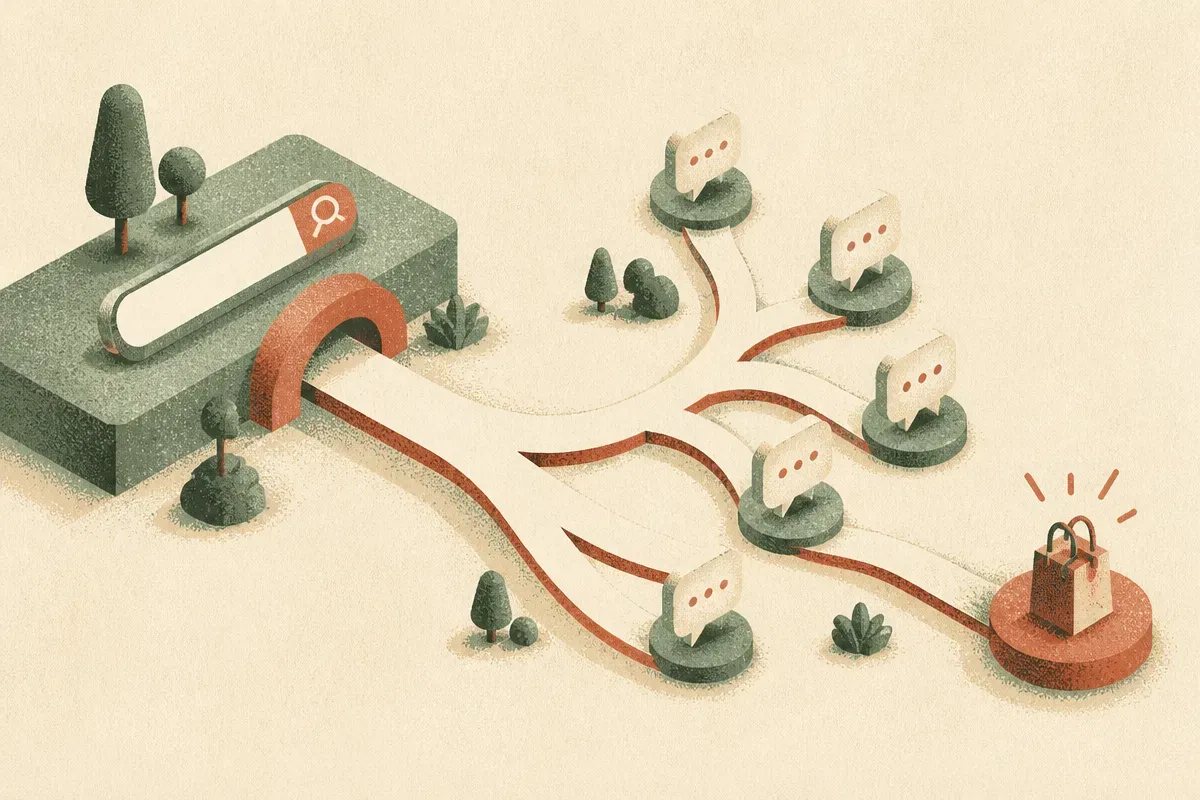
The old paid search mental model is simple: query, auction, ad, landing page. A user types “best CRM for small business,” sees sponsored links, clicks one, and the marketer judges performance from there. AI Mode changes the shape of that session. The user can ask a broad question, read an AI-generated answer, then ask a narrower follow-up. If ads can appear during those later turns, the commercial moment moves deeper into the conversation.
That matters because follow-up queries often contain stronger intent. “Best CRM” is research. “Which one works with Gmail and has call tracking?” is closer to a buying workflow. “Can it import HubSpot contacts?” is even closer.
Search Engine Journal’s report does not give pricing, auction mechanics, inventory limits, performance data, or a full country list in the material provided here. So I would not treat this as a finished playbook. Treat it as a signal: Google is trying to make ads native to AI search sessions, not bolted onto the first answer only.
Why do multiturn ads matter more than the country expansion?
The country expansion matters for reach. The multiturn piece matters for behavior.
Search marketers already optimize for keywords, landing pages, conversion events, and audiences. AI search adds a new variable: sequence. The user’s second or third prompt may be more valuable than the first one, and the ad system may eventually need to understand the path, not just the query snapshot.
That could reward brands with clearer positioning. If a user keeps refining around budget, compliance, integrations, local availability, or service quality, generic copy gets weaker. Specificity gets stronger. Pages that answer real buyer constraints may become more important, even when the paid click happens inside an AI-shaped session.
I run Lucky Domains’ SEO practice, so I’m watching this less as an ad-format novelty and more as another sign that search visibility is becoming a full-funnel content problem.
The risk is that advertisers overreact and declare classic SEO dead again. Don’t. Google has been blending ads, organic results, shopping units, maps, snippets, and AI answers for years. The surface changes. The job is still matching intent with useful proof, a clear offer, and a page that does not collapse when a qualified visitor arrives.
What should marketers test now?
I would start with query chains, not keyword lists.
Take your top commercial topics and write the next five questions a serious buyer asks after the first search. Not fantasy prompts. Real ones from sales calls, site search, support tickets, Reddit threads, comparison pages, and customer emails. Then check whether your ads and landing pages answer those follow-ups cleanly.
If you sell software, that might mean integrations, migration, permissions, pricing model, and support. If you sell local services, it might mean service area, timelines, insurance, proof of work, and how estimates happen. If you sell products, it might mean compatibility, returns, setup, warranty, and comparison against known alternatives.
The catch most readers miss: multiturn ads are not just a media-buying change. They expose weak positioning. If your offer only works when the user asks the exact keyword you bought, AI search will make that fragility more obvious. Build pages and campaigns around the conversation a buyer actually has, then watch where Google gives you new surfaces to meet it.