Crypto Liquidations Show AI Trades Share the Same Risk Pipe
Decrypt reported more than $1 billion in crypto derivatives liquidations as Bitcoin tested an 11-week low after AI stocks sold off. The useful read is not price direction. It is shared liquidity, crowded trades, and fragile risk assumptions.
TL;DR: The $1 billion crypto liquidation wave is a reminder that AI enthusiasm, crypto risk, and derivatives liquidity now sit closer together than many operators assume.
What actually happened?
Decrypt, in “Crypto Liquidations Top $1 Billion as Bitcoin Tests 11-Week Low,” reported that Bitcoin fell toward $75,500 after AI stocks plunged, with more than $1 billion wiped out in the crypto derivatives market.
That is the whole hard news item we have here. No need to decorate it.
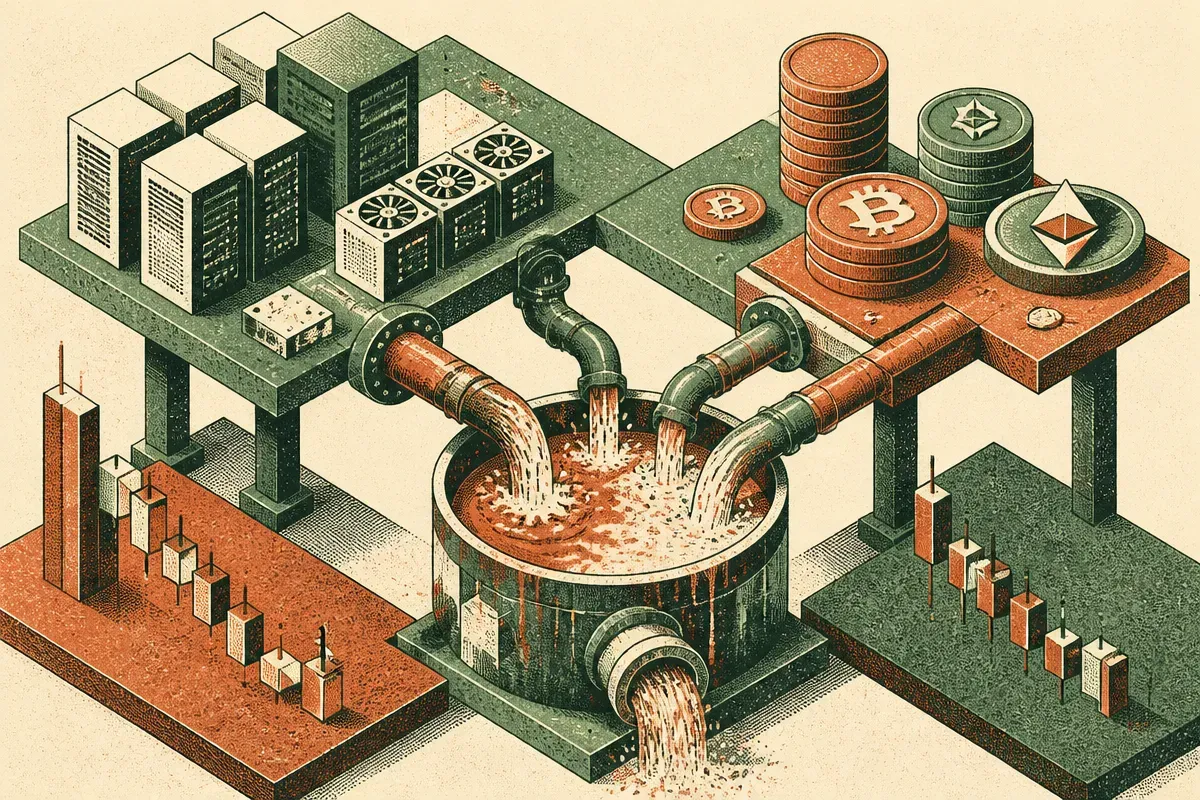
The useful point is not “Bitcoin did X because AI stocks did Y” as if markets are a clean diagram. They are not. But the sequence matters. AI-linked equities sold off, Bitcoin tested an 11-week low, and leveraged crypto positions were forced out. That tells us something about the plumbing.
When traders use borrowed money, the stated thesis matters less than the margin call. A position can be “long AI infrastructure,” “long Bitcoin,” “long risk,” or just “long number go up.” In a stress event, those can become the same trade. The system does not care what slide deck justified the exposure.
Crypto liquidations are especially loud because they are visible and mechanical. If collateral drops, positions close. If positions close, prices can move more. If prices move more, other positions close. That feedback loop is old. The wrapper changes.
Why would an AI stock selloff matter to crypto?
Because AI has become one of the main risk-on stories.
Not the only one. Not a magical master variable. But a major one. Nvidia, data centers, power constraints, private AI startups, cloud capex, model labs, enterprise adoption, all of it has pulled capital and attention into one big cluster of expectations. Some of those expectations are grounded. Some are stretched. Some are just momentum with better branding.
Crypto often trades inside the same attention economy. Different assets, different believers, different mechanics. Same appetite for duration, volatility, and convex upside. When confidence in the AI trade gets hit, the market can also reduce exposure in adjacent speculative buckets.
That does not mean Bitcoin is an AI asset. It means portfolios are not organized by clean narratives when volatility spikes. They are organized by liquidity, collateral, mandate, and pain.

This is where I think a lot of AI commentary gets too narrow. It watches model releases, benchmark jumps, and cloud announcements, then treats the financial layer as background noise. But funding conditions are part of the product cycle. If AI equities reprice hard, private valuations feel it. If private valuations feel it, hiring, compute commitments, startup runways, and enterprise procurement can all get tighter.
Again, no doom. Good products still matter. Real automation still matters. But the air gets thinner when the market stops rewarding every AI-adjacent promise.
What should an operator watch now?
I would watch second-order behavior, not price ticks.
Do AI startups start cutting inference costs more aggressively? Do vendors change contract terms? Do cloud commitments get renegotiated? Do enterprise buyers slow pilots because their own boards are suddenly asking sharper questions about AI spend? Those are practical signals.
On the crypto side, the lesson is simpler: derivatives can make the market look more decisive than it is. A billion dollars in liquidations is not the same thing as a billion dollars of thoughtful long-term capital changing its mind. It is forced selling and forced buying, depending on direction. That matters, but it is not wisdom.
The builder takeaway: treat “AI market sentiment” as an input to operations, not a vibe. If you are shipping AI products, run the boring checks now. What happens if GPU costs stay high but customers demand lower prices? What happens if your funding round takes longer? What happens if your AI feature is useful, but not useful enough to survive a budget review? The catch most readers miss is that market stress does not have to kill demand to change the game. It only has to make buyers and investors ask for proof sooner.