
GAS-PFN brings road topology into zero-shot traffic forecasting
GAS-PFN is a useful signal for applied forecasting: zero-shot models get stronger when their synthetic pretraining priors match the real structure of the system, in this case traffic sensors connected by roads.
TL;DR: GAS-PFN shows that zero-shot forecasting improves when the model is trained on synthetic tasks that encode the real structure of the problem, not just generic time-series patterns.
What did GAS-PFN actually change?
The primary work here is the arXiv cs.AI and cs.LG paper titled “GAS-PFN: Graph-Aware Spatiotemporal Prior-Data Fitted Networks for Zero-Shot Traffic Forecasting.”
The useful idea is not “another traffic model beat a benchmark.” The useful idea is that the model gets its advantage by baking road-network structure into the way it learns before deployment.
Prior-Data Fitted Networks, or PFNs, are trained to do in-context inference from synthetic tasks. That means the model is not fine-tuned on every new traffic network. It learns a task family during pretraining, then uses context at inference time to make predictions on a new setup.
That is a good fit for traffic, at least in theory. Cities change. Sensors move. Road networks evolve. A supervised graph model trained on one sensor graph can be strong, but it can also become a maintenance burden when the graph changes.
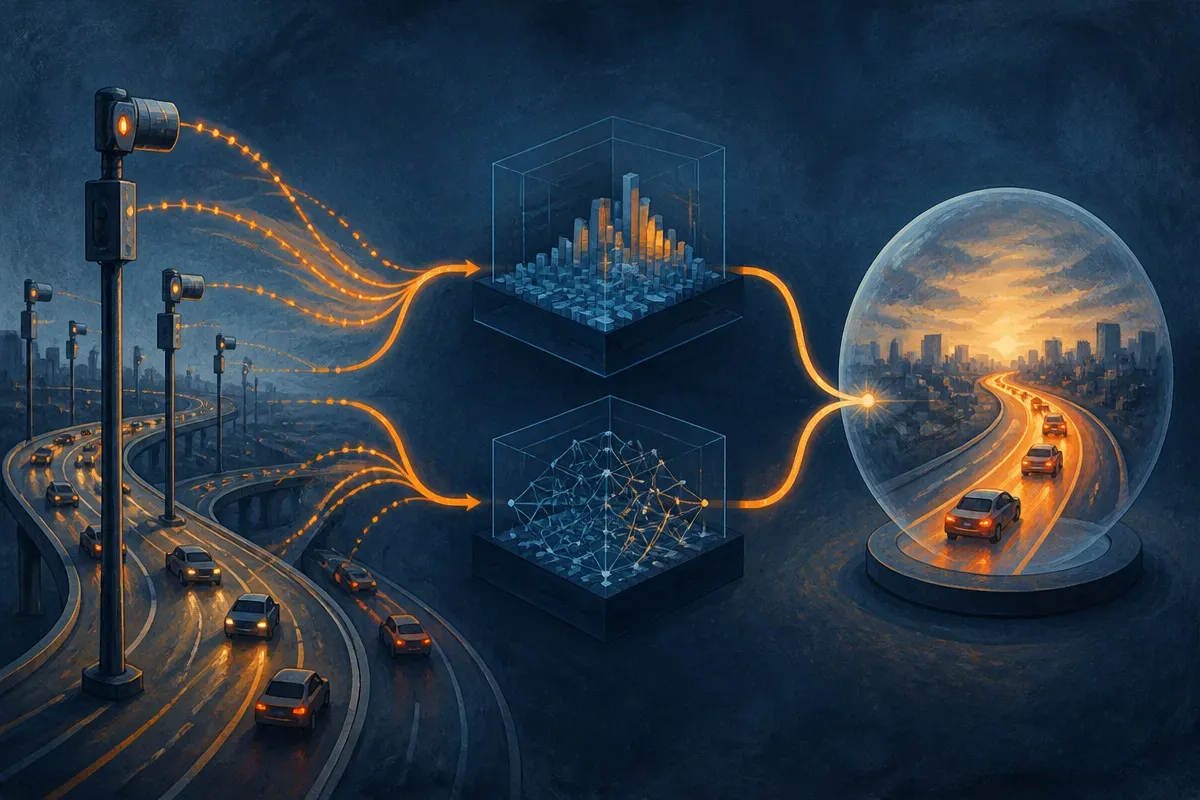
GAS-PFN adds the missing piece: graph-aware synthetic pretraining. It samples road topology and uses random-walk diffusion so the model sees traffic-like dependencies across connected sensors during pretraining. Then, at inference, it uses the target network’s structure and recent context without parameter updates.
That is the core move. Not more parameters. Not a bigger general forecaster. A prior that looks more like the system.
Why does graph structure matter for zero-shot forecasting?
Traffic is not just a sequence. A sensor reading depends on time, but also on what is happening upstream, downstream, and nearby. A jam propagates. A cleared bottleneck ripples. A road closure can make two sensors that are physically close behave very differently if the actual road graph does not connect them cleanly.
That is why generic time-series forecasting can hit a ceiling here. It can learn temporal patterns, but it may miss the spatial physics unless that structure is represented.
GAS-PFN’s architecture reflects this split. The paper describes two mask-conditioned passes through a shared Transformer backbone: one for sensor-specific temporal dynamics, one for spatiotemporal interactions among neighboring sensors. Those representations are then integrated for prediction.
This is a cleaner design than pretending every time-series problem is basically the same. It also points to a bigger pattern in applied AI: zero-shot works best when “zero-shot” does not mean “structure-free.” The model can be general at deployment because it was specific in the right way during training.
The reported numbers are strong, with an important caveat. Across six benchmarks at a 90-minute horizon, GAS-PFN reports a 34.0% average MSE reduction versus TimePFN, its closest PFN-based predecessor. It also reports a 27.7% average MSE reduction versus four recent industry-developed general-purpose zero-shot forecasters. In that comparison, all models receive 90 minutes of contiguous recent history, and extra context comes from each dataset’s chronological training split.
Good result. Still, the supplied material does not name those four industry forecasters, and it does not give the full experimental table. I would treat the direction as meaningful and the exact competitive ranking as something to verify in the full paper and code.
Where this matters beyond traffic
The lesson travels.
Many forecasting problems are not plain sequences. Power grids have topology. Supply chains have dependencies. Hospital capacity has flow constraints. Web traffic has referral graphs. Warehouses have physical layouts. If the structure matters, a generic forecaster may waste context trying to infer what the system designer already knows.
GAS-PFN is interesting because it frames structure as part of the prior, not as an afterthought bolted onto inference. That is a practical distinction. You can give a model a graph at prediction time, but if pretraining never taught it what graph-coupled dynamics look like, you are asking a lot from context alone.
The catch is that domain priors can also overfit the imagination of the model designer. If your synthetic tasks do not match the real failure modes, the model may look great in benchmark settings and brittle in deployment. Random-walk diffusion is a plausible traffic prior, but every city has weirdness: construction, events, weather, sensor outages, bad loops, and human routing behavior.
If I were building with this, I would not start by replacing a working traffic stack. I would run GAS-PFN-style evaluation as a shadow forecaster on new or changed sensor networks, especially where retraining is slow or expensive. Feed it the recent 90-minute context, include the road graph, compare it against the current supervised model during incidents, sensor gaps, and topology changes. The catch most teams miss: zero-shot is not magic generalization. It is compressed domain knowledge. The quality of that compression is the product.