
Luxor’s $16M AI compute bet is about trading scarcity
Luxor’s reported raise shows how Bitcoin mining infrastructure is being repackaged for AI compute, but the interesting part is not miners chasing GPUs. It is the attempt to make compute capacity, hardware access, and price risk easier to trade.
TL;DR: Luxor’s reported $16 million raise is less about Bitcoin miners “pivoting to AI” and more about turning scarce compute, power, hardware, and price risk into something operators can source and trade.
What did Luxor actually raise money to do?
My primary source here is The Block’s “Bitcoin mining infrastructure firm Luxor raises $16 million to expand AI business,” because it includes the most specific operating detail: COO Ethan Vera told The Block that Luxor plans to hire about 12 people by year-end.
Across The Block, Decrypt, CoinDesk, and CoinTelegraph, the reported headline is consistent. Luxor raised $16 million in a round led by CMT Digital. Decrypt reported participation from mining-hardware makers Canaan and MicroBT. The proceeds are reported to support Luxor’s expansion into AI infrastructure, GPU sourcing, hardware, compute trading, and derivatives.
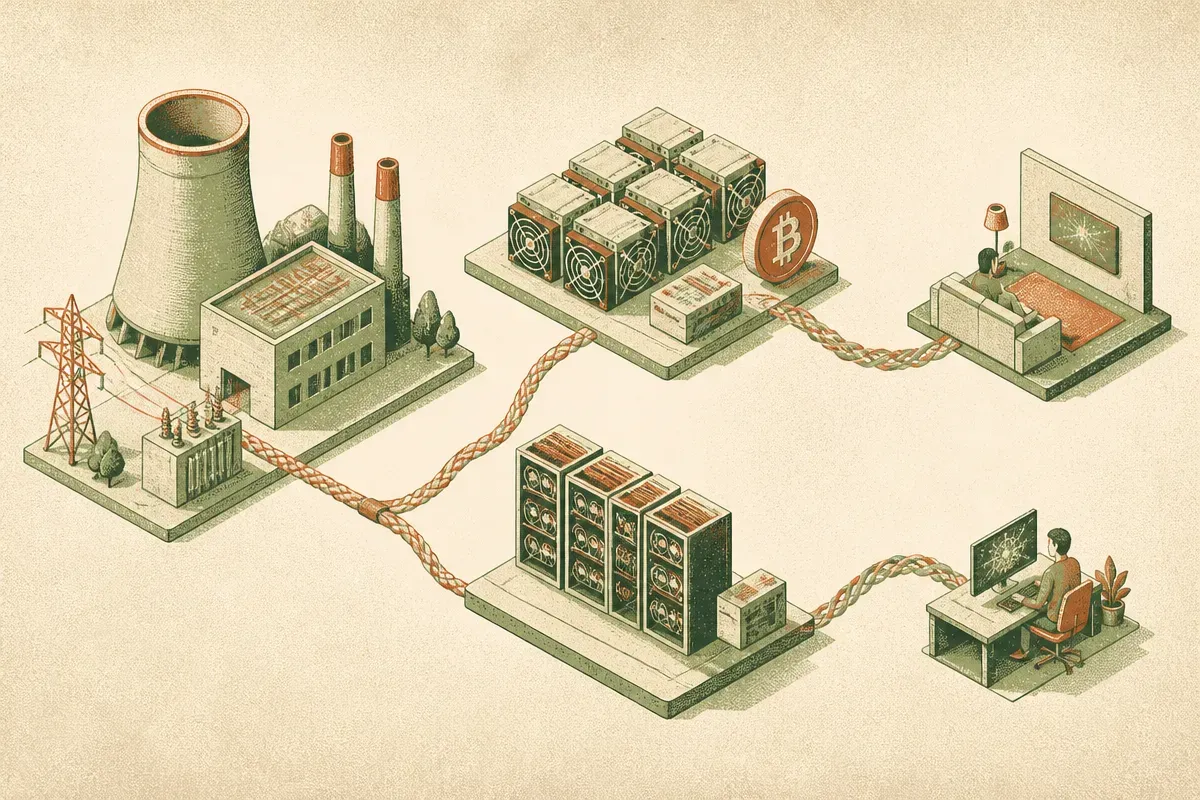
That bundle matters. This is not a clean “Bitcoin company becomes AI company” story. Luxor already sits in mining infrastructure, where operators think in power contracts, machine procurement, hosting, uptime, and commodity-like pricing. AI compute has a different customer base, but many of the same physical constraints: access to chips, cheap power, rack space, cooling, financing, and buyers who do not want to be exposed to ugly price swings.
CoinDesk framed the bigger bet clearly: Luxor is betting that computing power becomes a market where companies can hedge costs and prices. That is the real story. Not GPUs as a buzzword. Market structure.
Why are Bitcoin mining firms interested in AI compute?
Bitcoin miners know how to turn electricity into revenue through machines in warehouses. AI infrastructure asks a nearby question: can you turn electricity, facilities, and scarce hardware into rented training or inference capacity?
Nearby does not mean easy.
Bitcoin ASIC fleets and AI GPU clusters are different animals. ASICs do one job. GPUs are more flexible, more expensive, and more operationally demanding. AI customers care about networking, memory, scheduling, software stacks, data movement, reliability, and support. A mining warehouse is not automatically an AI data center because someone says “H100.”
Still, the overlap is real. Miners have relationships around power and sites. Some have experience operating at scale under thin margins. They also understand cycles. When mining economics get tight, AI compute can look like a higher-value use of energy and infrastructure.
CoinTelegraph reported that Luxor wants to scale its existing AI infrastructure business and expand GPU sourcing as global chip supply chains remain constrained. That phrase, GPU sourcing, is the practical tell. A lot of AI companies do not just need “cloud.” They need capacity they can actually get, at a predictable cost, on a timeline that matches product or training plans.
Is compute really becoming a tradable market?
Parts of it already are. Cloud reserved instances, spot markets, hosting contracts, colocation deals, and GPU rental platforms all price compute in different ways. What Luxor appears to be pushing, based on the reporting, is a more finance-native layer around that mess: trading, sourcing, and hedging.
That could be useful. It could also get overbuilt with jargon.
The useful version helps AI operators answer boring, expensive questions. Can I lock capacity before launch? Can I reduce exposure to GPU price spikes? Can I source hardware without spending months inside vendor channels? Can I match idle capacity with real demand?
The risky version turns compute into another speculative wrapper where the paper market outruns the physical one. That risk is especially obvious because this story sits at the intersection of crypto capital, mining cycles, AI hype, and constrained chips. All four can attract serious builders. All four can also attract tourists.
The thing I am watching is whether customers get better access, clearer pricing, and more reliable delivery. If yes, compute trading becomes infrastructure. If no, it becomes a narrative.
Practitioner’s take: if you are building AI products, do not read this as “miners will solve compute.” Read it as a sign that compute procurement is becoming strategic. Track your real workload shape, training versus inference, burst versus steady demand, latency needs, and tolerance for capacity risk. Then compare cloud, reserved capacity, hosted GPUs, and brokered supply. The catch most teams miss is that cheap compute is only cheap if it shows up when your product needs it.