Clinical notes as an early warning layer for hospital mental health risk
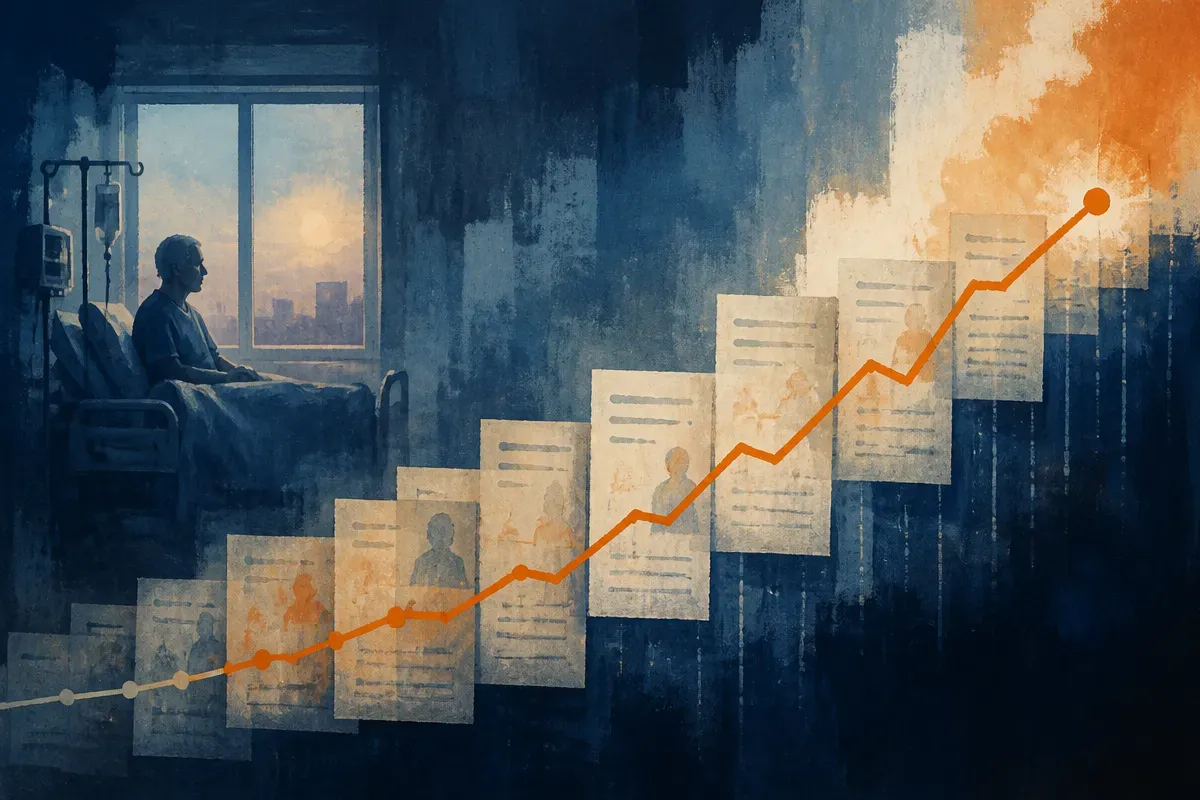
An arXiv paper on chronically ill hospitalized patients points to a practical AI pattern in medical settings: track risk as a trajectory across daily notes, not as a one-time prediction from a discharge summary.
TL;DR: The useful idea is not “AI diagnoses depression from notes,” it is tracking changing mental-health risk signals over a hospital stay so clinicians can see when a chronically ill patient may need attention.
What is the paper actually testing?
My primary source is the arXiv paper “Beyond Physical Illness: Can Clinical Narratives Reveal Emerging Mental Health Risks in Chronically Ill Patients?”, listed under cs.AI and cs.LG.
The setup is specific. The paper looks at chronically ill patients who are hospitalized primarily for physical illness, not patients already selected because they have psychiatric diagnoses. That matters. Most hospital AI work gets easier when the label is obvious. This work is asking whether mental-health risk can surface in the messy middle of care, inside longitudinal clinical narratives.
The researchers construct a weakly supervised cohort of around 4,000 patients from MIMIC-III. They use mental-health evidence extracted from discharge summaries to define risk signals, then model day-wise clinical narratives during hospitalization. The target risks include depression, dementia, and suicidal ideation.
That is a useful framing, but it is also where the caution starts. Weak supervision is not ground truth. Discharge summaries are written after the fact, by humans, under clinical and billing constraints. They may miss subtle distress, overrepresent documented problems, or bake in institutional habits. So I would read the result as “there may be signal here,” not “the model has found hidden mental illness.”
Why does the time dimension matter?
The interesting technical move is the hierarchical state-space framework. In plain English: the model derives mental-health representations from daily notes, then models how those representations change over time.
That is better aligned with real hospital work than a single classifier slapped on a chart. A patient can look stable on admission, become confused after a medication change, show signs of despair after bad news, or improve after pain is controlled. The risk is not just a category. It is a path.
The paper reports improved binary risk prediction using the proposed representations, and says model-derived trajectories differ between risk and no-risk cohorts. Those are preliminary results, not a clinical product. Still, the shape of the approach feels right.

A static model gives a yes or no. A trajectory model gives staff a chance to ask, “What changed?” That is the part I care about. In medicine, a tool that prompts a better question can be more useful than a tool that pretends to give the final answer.
What would make this safe enough to try?
The missing pieces are not glamorous. Calibration. External validation. Bias checks. Workflow testing. Clear handoff rules. A mental-health risk trajectory is only useful if a clinician trusts when it rises, understands what evidence drove it, and knows what action follows.
False positives are not harmless here. They can consume scarce psychiatric resources, stigmatize patients, and add noise to already overloaded teams. False negatives are worse in a different way, because they create fake reassurance. Any deployment would need to show performance across units, diagnoses, demographics, note-writing styles, and hospitals outside MIMIC-III.
I would also want the system to cite note-level evidence without exposing sensitive content more widely than necessary. “Risk increased” is not enough. “Risk increased after three days of notes showing worsening confusion, refusal of care, and family concern” is closer to something a care team can verify.
My practitioner’s take is simple: if you are building in medical AI, do not start with a grand diagnostic copilot. Start with a narrow temporal monitor for one workflow, one unit, and one escalation path. Test whether daily-note trajectories help clinicians catch patients they would otherwise miss. The catch most readers miss: the model is not the intervention. The intervention is the staffing, protocol, and accountability that happen after the alert.