
AI prose gets hard to read when it removes friction
A Hacker News question about confusing AI prose points at a practical writing problem: models often replace context, stakes, and human intent with smooth connective tissue. The fix is not more polish. It is stronger constraints, named actors, and fewer generic abstractions.
TL;DR: AI-generated writing is often hard to understand because it sounds finished before it has done the hard work of choosing a point, naming the actor, and preserving context.
Why does AI-generated language feel clear but land fuzzy?
The primary source here is the Hacker News thread titled “Why is AI generated language so hard to understand?” That question is more useful than another complaint about “AI slop,” because it points at the real failure mode: not bad grammar, bad compression.
A lot of model-written prose has the surface traits of clarity. Short paragraphs. Balanced clauses. Familiar transitions. No obvious typo trail. It often reads, at first glance, like competent business writing.
Then you try to act on it.
Who is supposed to do what? Compared with what? Under what constraint? Is this a claim, a recommendation, a warning, or filler dressed up as judgment?
That is where the sentence collapses.
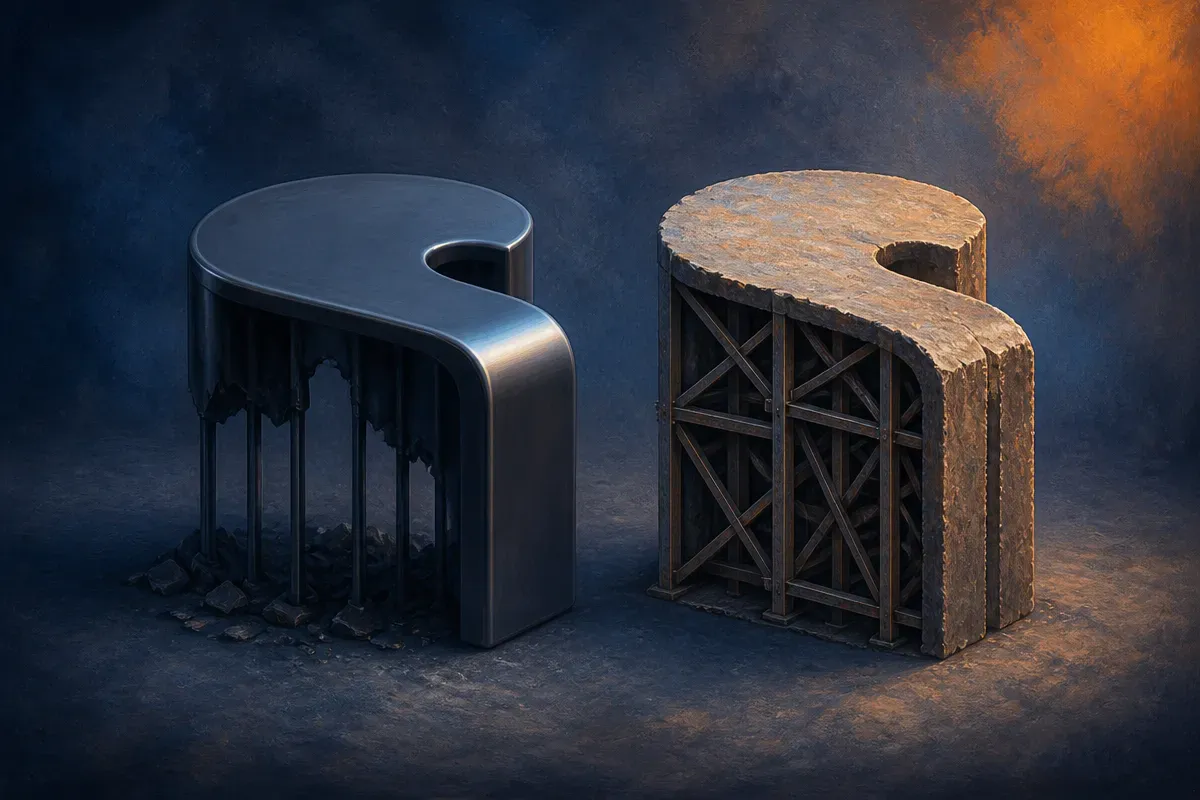
My read: models are good at producing the shape of explanation, but they often blur the load-bearing parts. They swap concrete nouns for category words. “Teams” replace named roles. “Solutions” replace tools. “Efficiency” replaces a measurable change. “Users” replace a person with a problem.
The result is language that feels polite and complete, while forcing the reader to rebuild the missing context.
What makes model prose harder than normal bad writing?
Normal bad writing usually has a visible cause. The writer is rushed, evasive, inexperienced, or trying to sound important. You can often see the mistake.
AI prose is stranger because the mistake is hidden by fluency.
The model does not get tired. It does not ramble in the same way a person does. It can maintain tone and syntax for pages. That consistency makes weak ideas harder to spot. The paragraph does not announce that it has no center. It glides.
There is also a feedback trap. Many people ask AI tools to “make this more professional,” “improve this,” or “polish this.” Those prompts often remove the very details that made the original useful: a weird example, a hard constraint, a sharp opinion, a named customer, a messy caveat.
So the model cleans the prose by sanding off signal.
This is why AI writing can be worse after editing. Not always. But often enough to matter. A rough human draft might say, “The onboarding email is confusing because it asks free users to book a sales call.” The polished AI version might say, “The onboarding flow could benefit from clearer alignment between user intent and conversion pathways.”
The second sentence sounds smarter. The first one tells you what to fix.
How should builders prompt for readable AI output?
The best fix is not “write more naturally.” That prompt is vague. The model will imitate whatever “natural” means in its training mix, which may mean more soft filler.
Ask for decisions instead.
Tell the model to name the actor in every recommendation. Tell it to replace abstractions with examples. Tell it to keep operational details even if the sentence gets less elegant. Tell it to flag any claim that lacks evidence. Tell it to remove a sentence if it does not change what the reader would do next.
For editing, I like prompts that make the model less like a copywriter and more like a skeptical line editor. For example: “Rewrite this so every paragraph has one concrete claim, one named object, and no generic business language.” Or: “List the sentences that sound meaningful but do not commit to anything.”
That second one is brutal. Useful too.
The catch most readers miss: AI prose is not hard to understand because machines use big words. It is hard to understand because it often avoids tradeoffs. A builder using AI for docs, marketing, support, or internal workflows should test output with one question: after reading this, can someone do the right next thing without asking a clarifying question? If not, do not ask for more polish. Add constraints, names, examples, and stakes.