
Wikipedia Game results show why AI search still needs guardrails
A Wikipedia navigation benchmark suggests frontier LLMs can match human link-following in some retrieval tasks, but performance shifts by language and domain. That matters for anyone building AI search, RAG, or agent workflows over messy knowledge graphs.
TL;DR: LLMs can navigate knowledge graphs surprisingly well, but the Wikipedia Game benchmark shows they are not reliably better than humans, especially once language and domain change.
What does the Wikipedia Game actually test?
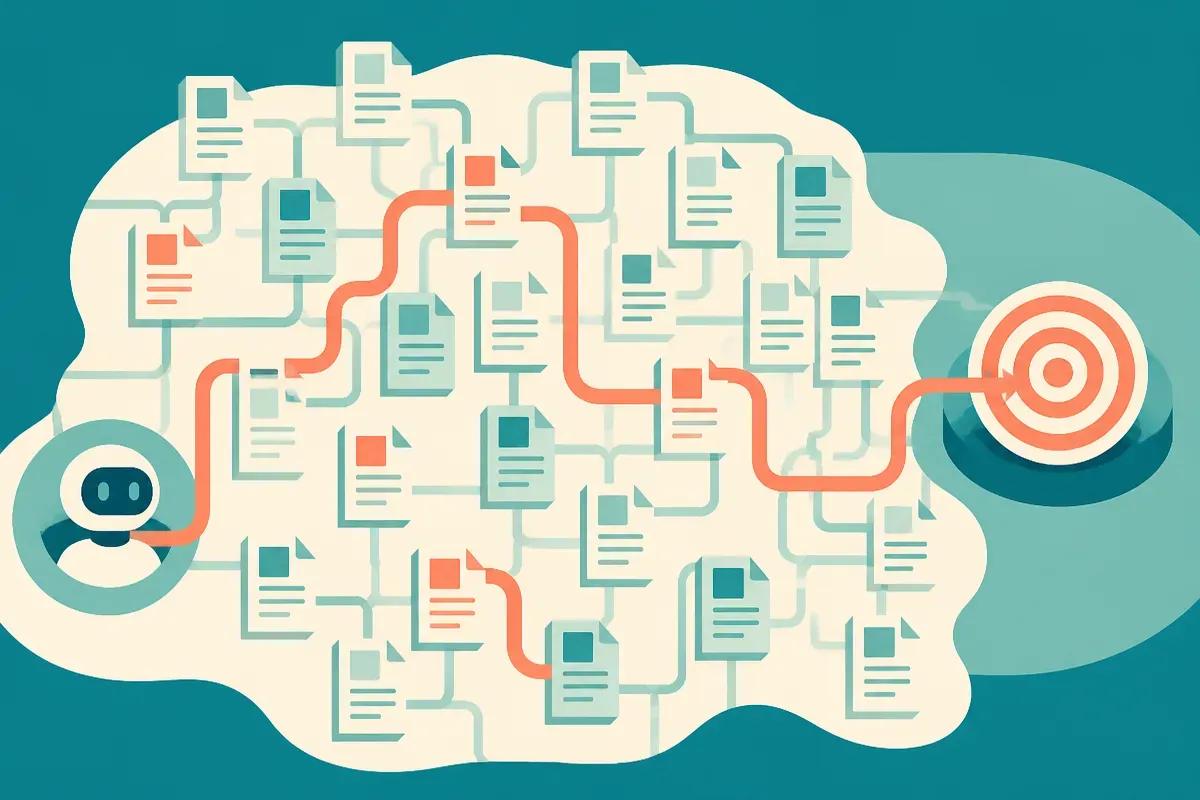
The primary source here is the arXiv cs.AI paper titled “Can Language Models Play the Wikipedia Game?” It uses a familiar internet game as a proxy for a serious retrieval problem: start on one Wikipedia article, reach a target article, and only move through links on the current page.
That sounds cute. It is not just cute.
A lot of applied AI search has the same shape. You have a huge document collection, a user wants something specific, and the system has to make a chain of choices through partial information. Search result, passage, citation, entity, related doc, next step. If the system picks a bad branch early, the rest of the reasoning can look confident while drifting away from the answer.
The paper compares sentence embedding models and LLMs across five Wikipedia languages and five academic-literature datasets. It also builds large local graphs of Wikipedia pages and paper citations using OpenAlex, which matters because the evaluation does not depend on live third-party APIs or whatever ranking layer happens to sit between the model and the corpus.
That is the part I like. Benchmarks that quietly rely on external search APIs often measure the API, the index, the snippet format, and the model all at once. This setup tries to isolate navigation ability: can the model choose useful next links when the graph is known?
Did the models beat humans?
Not really.
The paper reports that no model significantly outperformed humans. The best models, GPT-o3 mini, GPT-4o, QwQ:32B, and DeepSeek-R1:70B, reached comparable success. That is a useful result because it cuts both ways.
For the optimistic side, comparable-to-human graph navigation is impressive. If you are building research assistants, citation explorers, internal knowledge tools, or agentic search, this says the stronger reasoning models can make decent local navigation calls. They are not just keyword matchers with a nicer voice.
For the skeptical side, “comparable” is not “solved.” Humans are not an impossible ceiling here. A good retrieval system should often beat a person at repetitive link selection, especially when it can score many candidates, keep state, and avoid fatigue. If a model merely matches humans in a constrained game, that is promising, but it is not proof that autonomous search agents can roam enterprise knowledge bases without supervision.
The cross-language and cross-topic variance is the warning label. Rankings changed across languages and domains. That is exactly where many AI search demos hide the mess. English Wikipedia about popular topics is one world. Specialist academic literature, non-English corpora, and sparse internal docs are another.
Why should builders care?
Because RAG failures often get blamed on the wrong layer.
When an AI answer is bad, teams tend to argue about prompt wording, chunk size, embedding model, reranker choice, or whether the LLM “reasoned” enough. Those all matter. But this paper points at a more basic failure mode: navigation policy. Given a graph of possible next moves, does the system choose a path that gets closer to the target?
That is different from semantic similarity. A link can look semantically close and still be a dead end. A citation can be adjacent to the right field and still miss the result. A page can share vocabulary with the query while offering no useful path forward. The Wikipedia Game is useful because it forces the system to act step by step, not just retrieve the top 10 nearest chunks and hope the generator cleans it up.
For production systems, I would treat this as an argument for evaluating retrieval as a trajectory, not a single hit. Log the steps. Score intermediate choices. Compare the model against simple baselines like TF-IDF, not just against another expensive model. Test by language and topic instead of averaging everything into one happy number.
A builder should try this pattern on their own corpus: turn docs, links, citations, tickets, entities, or pages into a local graph, then ask models to navigate from known starting points to known targets. The catch most readers miss is that the answer quality at the end is often less important than the path taken to get there. If the path is unstable, your agent is not searching. It is wandering with good grammar.