
Venice’s bond market is the better AI infrastructure analogy
A thin historical pointer about Venice and the first bond market is a useful reminder for AI builders: the durable innovation is often the financing and coordination layer, not the dramatic event that forced it into existence.
TL;DR: The useful lesson from Venice is not “finance is clever,” it is that expensive, risky systems often become scalable only after someone invents a repeatable way to fund and transfer the risk.
What does Venice have to do with AI?
The primary source here is the Hacker News item titled “Venice’s failed war against Constantinople led to the first bond market.” That is a tiny source, but the premise is useful: a failed military project helped produce a financial mechanism that outlived the crisis.
That is usually how important infrastructure gets built. Not from clean strategy decks. From a hard constraint.
Venice needed to fund war and state operations. The mechanism that emerged, broadly, was a way to turn public obligation into something people could hold, price, and trade. The point was not that Venice discovered “yield.” The point was that a messy collective burden became legible enough to move between parties.
AI has a similar shape right now. The constraint is not only model quality. It is capital intensity, compute scarcity, energy access, data-center timelines, chip supply, model risk, customer concentration, and the fact that nobody fully knows how profitable frontier AI will be at maturity.
The loud story is models. The quieter story is financing.
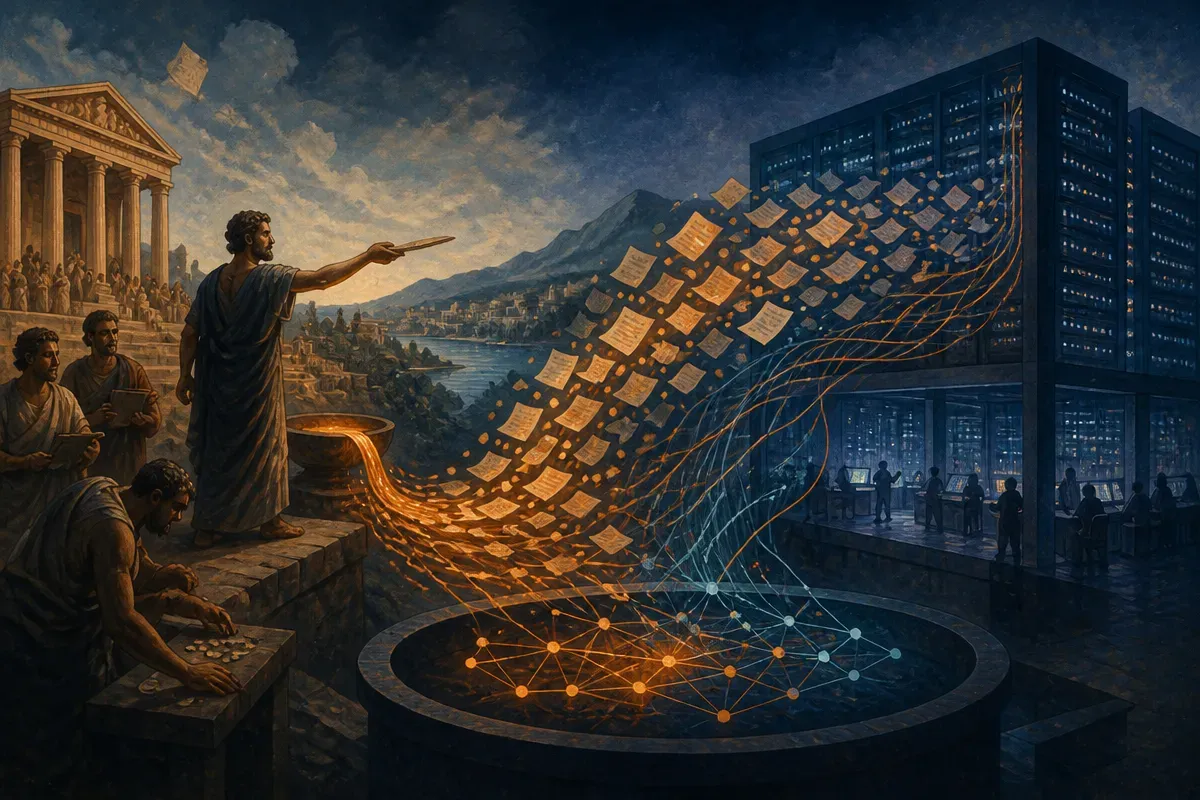
Is the real AI moat the model, or the funding structure?
For frontier labs, the model is the visible artifact. The funding structure may be the operating system.
OpenAI, Anthropic, Google DeepMind, Meta, xAI, Mistral, and others are not just competing on architecture and post-training. They are competing on who can assemble enough compute, talent, distribution, and patient capital to survive several more expensive training cycles.
That does not mean every AI company needs to become a financial engineer. It does mean operators should stop treating infrastructure finance as background plumbing. Power purchase agreements, GPU leases, cloud credits, enterprise prepayments, sovereign deals, revenue shares, and data partnerships can shape product strategy as much as model choice.
There is also a trap here. History is full of useful financial inventions and terrible speculative copies. A bond market can fund canals, wars, railroads, and data centers. It can also package fantasy. If the Venice analogy gets dragged into AI tokens, “compute-backed” narratives, or synthetic claims on future model revenue, the right posture is caution. Tradable wrappers do not make weak cash flows strong. They just make them easier to spread around.
No price predictions. No token cheerleading. The operator question is simpler: what real constraint is being financed, who bears the downside, and what measurable output improves because this structure exists?
What should builders watch?
Watch for products that convert scarce AI inputs into standardized units.
That could be compute marketplaces with verifiable availability. It could be inference routing that makes capacity fungible across providers. It could be model evaluation contracts that let buyers compare risk before committing spend. It could be insurance-like products around downtime, data leakage, or failed automation. It could be financing for private deployments where the customer pays over time because the upfront implementation cost is too high.
The best versions will make something opaque more legible. The worst versions will rename leverage as innovation.
This matters for smaller builders too. If you are building with AI, your edge may not be training a better model. It may be packaging an uncertain workflow into a reliable commercial unit: fixed-scope audits, measurable support deflection, domain-specific agents with human review, or content operations tied to actual search visibility and conversion instead of vague “AI transformation.”
For builders, try mapping your AI product like a risk transfer system. What cost or uncertainty does the customer have today? What part can your product absorb, price, reduce, or make tradable inside their organization? The catch most readers miss: the winning invention may not look like AI at all. It may look like a contract, a dashboard, a guarantee, or a boring payment term that finally lets the AI system get adopted.