
MatLoom makes generated materials editable, not just pretty
MatLoom points at a useful direction for asset generation: compact programs that render materials, preserve construction logic, and give artists something editable after the model’s first pass.
TL;DR: MatLoom’s real claim is not better texture generation, it is that generated materials should arrive as editable construction rules, not dead image outputs.
What is MatLoom actually generating?
My primary source is the arXiv cs.AI and cs.CL paper, “MatLoom: Layered Text-to-Material Generation in a Compact Program Space.” The core idea is simple and useful: a text-to-material system should not only make a surface look right, it should keep the recipe.
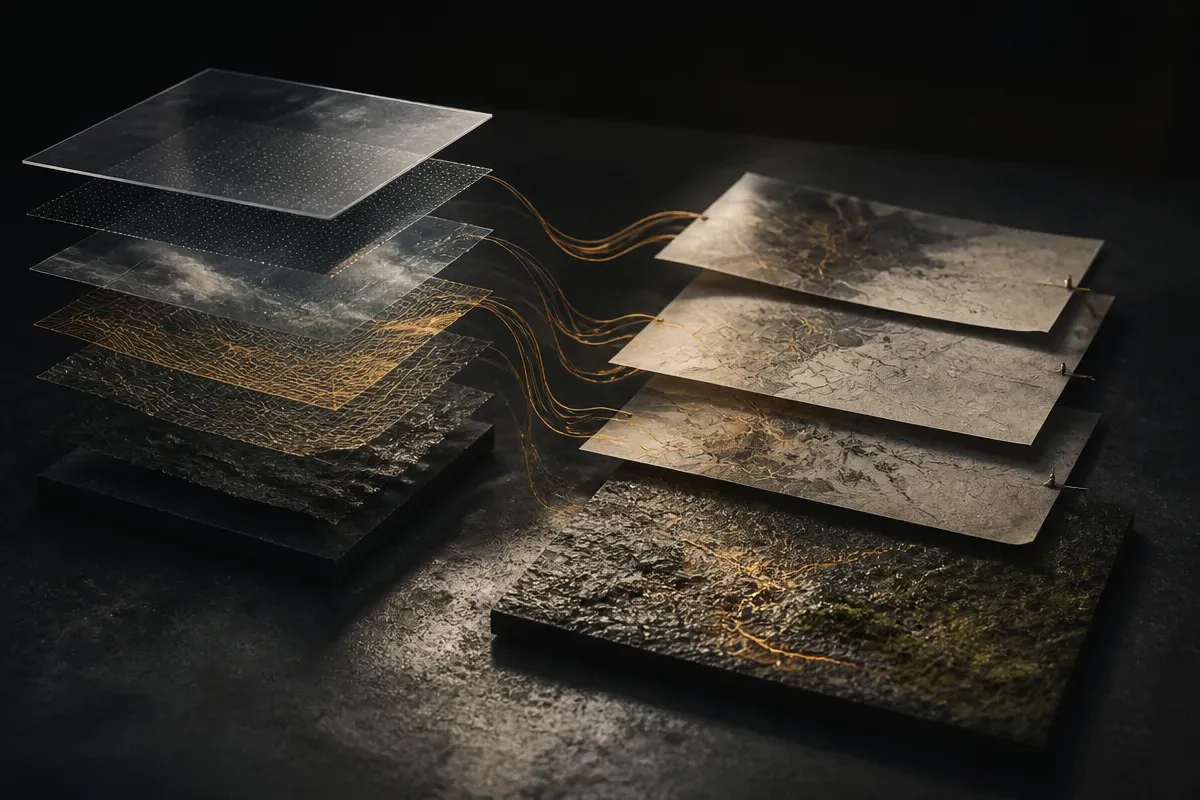
MatLoom represents materials as compact executable programs. Each program is made from alpha-masked layers. Those layers share spatial expressions across appearance and physically based rendering channels, so pattern, color, and relief are tied together instead of being separate image guesses. A standalone interpreter then turns the program into material maps.
That sounds nerdy, but it matters. A diffusion model can give you a plausible woven fabric, cracked paint, or ceramic tile. MatLoom tries to give you the construction logic behind that result. The paper reports that retained programs have a median length of 21 lines across backbones. That is short enough to inspect, edit, and regenerate.
This is the part that feels more production-shaped than another pretty texture demo. If the output is a program, a human can change a named field or layer parameter later. The asset is not just pixels. It has handles.
Did the program approach beat diffusion?
According to “MatLoom: Layered Text-to-Material Generation in a Compact Program Space,” the system was tested on a curated benchmark of 141 prompts using six pretrained language model backbones. The best configuration scored higher than three diffusion baselines across all four flat-layout prompt-alignment metrics. The paper also says MatLoom’s initial programs exceeded all three baselines on mean BLIPScore before critique or seed search.
That last bit is important. The system is not only winning after a long polishing loop. The first executable programs are already competitive on one reported alignment metric.
The pipeline has a few stages. It uses parser-guided repair to fix invalid programs, preview-based critique to revise material designs, then searches noise seeds while keeping the rest of the source fixed. That is a pragmatic pattern: constrain the model into a small language, repair syntax, critique previews, then vary randomness only where needed.
The human preference number is the cleanest receipt in the paper. In a blind four-way comparison with 30 participants and 20 prompts, MatLoom renders received 59.2% of choices. The most-preferred baseline got 19.3%.
I would not overread that. Thirty people and 20 prompts is useful, not definitive. The benchmark is curated. The reported flat-layout metrics are not the same as shipping a game material, a product configurator, or a film asset. But the direction is credible: structure can beat raw image generation when the task needs editability.
Why does editability change the value of generated assets?
Generated media often fails at the handoff. The first render looks good. Then the client asks for the stripes to be wider, the cracks to follow a different spacing, or the relief to match the same motif as the color pattern. If the generator only emitted images, you are back to prompting, masking, repainting, or manually rebuilding.
MatLoom attacks that failure mode by making dependencies explicit. Coverage, pattern, color, and relief can be linked through shared expressions. That gives the system a chance to make coherent changes instead of painting over its own output.
This also hints at a broader AI product pattern. For creative tools, the best output is often not the final artifact. It is a compact, editable intermediate representation that professionals already know how to steer. Code for apps. Graphs for workflows. Timelines for video. Layer programs for materials.
There is still a catch. Someone has to like the language. If MatLoom’s compact program space is too limited, artists will hit a ceiling. If it is too expressive, generation and repair get harder. The sweet spot is not “generate everything.” It is “generate enough structure that the next human edit is cheap.”
My practitioner’s take: if you build asset tools, do not treat this as a texture model to copy. Treat it as an interface lesson. Pick a constrained representation your users can edit, generate into that, validate it, preview it, then let the model revise within the structure. The catch most teams miss is that editability has to be designed before generation, not patched on after the image looks good.