
Ling 3.0 Tiny makes old CPUs interesting again
A LocalLLaMA test of Ling 3.0 Tiny on a 2017 laptop is not proof of a local AI revolution, but it is a useful signal: small active-parameter models are getting good enough for background tasks on hardware people already own.
TL;DR: The practical edge AI story is not tiny models replacing frontier models, it is tiny active models becoming useful enough to run boring background jobs on old machines.
What actually ran on the old laptop?
The primary source here is the r/LocalLLaMA post “Ling Tiny 3.0 is a glimpse of the future” by /u/netherreddit, and the useful part is the specificity.
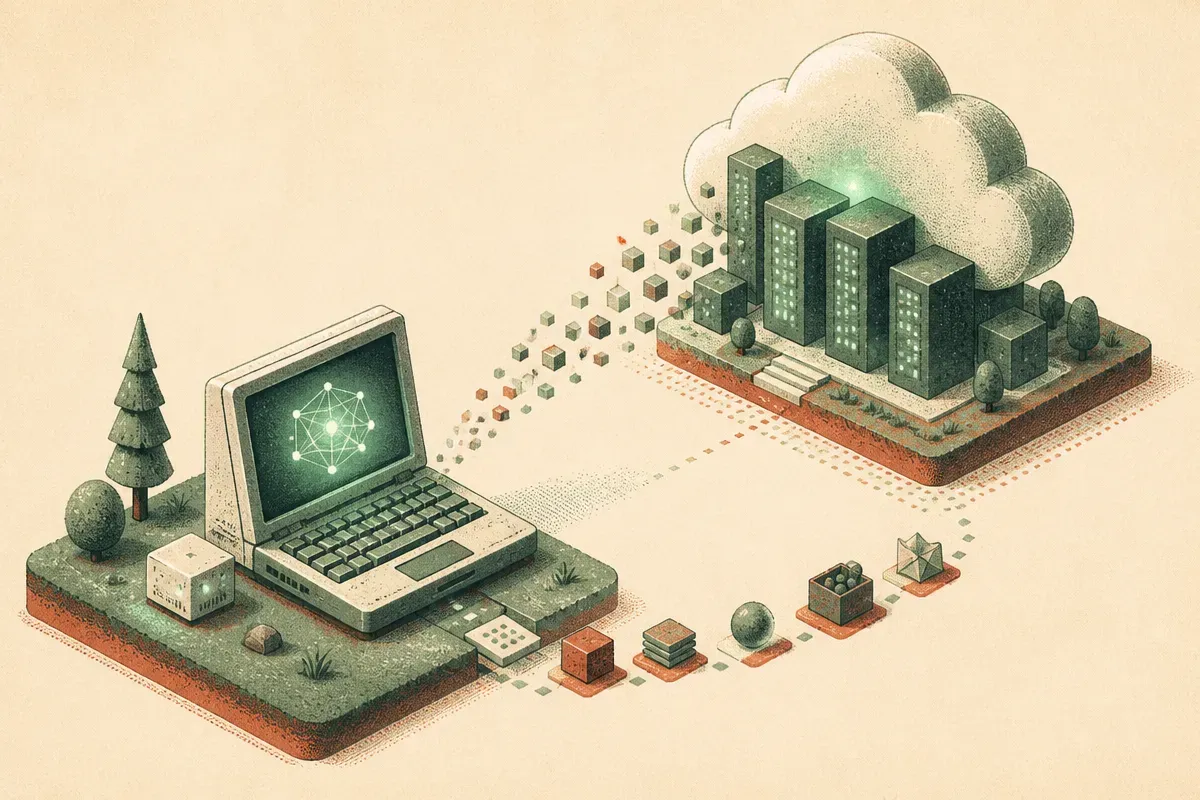
They reported running Ling 3.0 Tiny, described as an 8 billion parameter MoE model with 1 billion active parameters, through llama.cpp on a 2017 laptop with a 7th gen i5, 8 GB of RAM, no VRAM, and no GPU. Not a homelab monster. Not a Mac Studio. A tired laptop.
The task was modest but real: write a script to scan the local network for available models on llama.cpp servers. The model reportedly ran around 10 tokens per second using a Q6 quant, with “basically no optimization effort.” Over about 20 minutes, it wrote code, ran it, got feedback, and iterated through several turns.
That is the interesting bit. Not the benchmark score. Not a leaderboard jump. A small model on bad hardware did a task that would have taken a human hobbyist maybe an hour or two in 2020, according to /u/netherreddit.
I would not stretch this into “old laptops are now AI workstations.” They are not. Larger systems will still be faster, cheaper per useful token in many cases, and much easier to manage at scale. But this is a different category of usefulness: slow, local, cheap-enough intelligence sitting near the files, ports, logs, folders, sensors, or devices it needs to inspect.
Why does 1 billion active parameters matter?
MoE matters here because the full model size is not the same as the compute used per token. If Ling 3.0 Tiny really is 8B total with 1B active, the local machine is not doing the same kind of work it would do for a dense 8B model. That distinction is why the “potato hardware” framing is not just vibes.
The claim to watch is not “8B runs on anything.” The claim is narrower: a model with a small active footprint can be responsive enough on old CPUs for certain jobs, especially when the job tolerates latency.
That is a big opening for local AI workflows. Think maintenance scripts. File cleanup. Log triage. LAN inventory. Local note classification. Personal data extraction where cloud upload is not acceptable. Small coding loops where waiting 20 minutes is fine because the alternative is never doing the chore at all.
This is also where a lot of AI product thinking gets backwards. Everyone wants the assistant that feels instant and brilliant. But many valuable jobs do not need instant. They need unattended, private, good-enough execution over a constrained surface area.
What is the catch?
The catch is reliability. A local model that writes a network scanner can also write a broken one, a noisy one, or one that misses half the environment. Small models are more attractive when the task has tight feedback loops: run the script, inspect the output, fix the error, repeat. They are less attractive when a quiet mistake is expensive.
So I would treat this as a design pattern, not a product verdict. Put small local models behind narrow tools. Give them read-only defaults. Log their actions. Keep humans in the loop for changes that touch production systems, credentials, billing, deletion, or public output.
The other catch is energy and time. /u/netherreddit correctly notes that expensive rigs remain more power efficient, cost efficient, and fast at producing tokens. An old CPU doing 10 tokens per second is charming, but charm is not an operating model. If a task runs every five minutes forever, use the right hardware. If it runs once a week while a retired laptop sits on a shelf, maybe the math changes.
For builders, the move is simple: take one annoying local workflow and test it on the worst machine you still own. Use llama.cpp. Pick a small quantized model. Give it a bounded task with a pass/fail check, like generating a report from local files or writing a script against a sandbox. The thing most readers miss: the win is not replacing your main AI stack. The win is creating a low-stakes local worker for jobs that were too small, too private, or too boring to justify a real system.