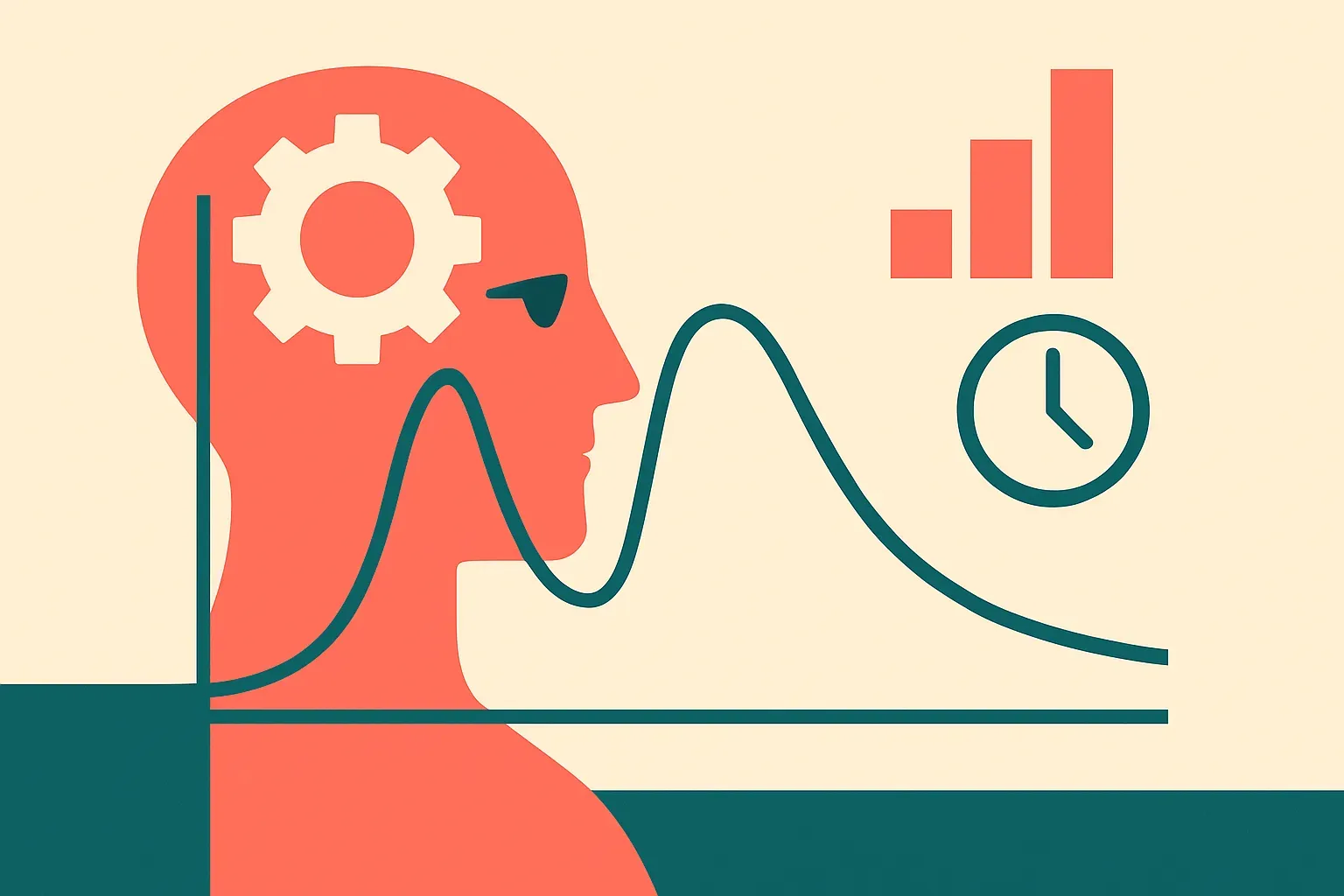
Double descent as an implicit regularization story
The arXiv paper “Double descent is the principle of least action” reframes a weird training curve through statistical mechanics, arguing that extra parameters can lower effective temperature and act like regularization after the interpolation peak.
TL;DR: Double descent is not a magic reason to make every model bigger, but it helps explain why overparameterized models can generalize after the point where old-school intuition says they should collapse.
What is double descent, really?
The primary source here is the arXiv cs.AI/cs.LG paper “Double descent is the principle of least action.” It tackles one of the stranger empirical patterns in modern ML: as model size grows, test error can fall, then spike when the model is just large enough to fit the training data, then fall again as the model gets even larger.
That middle spike is the uncomfortable part. Classical bias-variance intuition says bigger models should eventually overfit. In the double descent picture, the danger zone sits around interpolation, where the model has just enough capacity to memorize the training set. Past that point, extra parameters can make good solutions easier to find, not harder.
The paper’s move is to explain this with statistical mechanics. A stochastic gradient method is treated like a particle wandering across the loss landscape at an induced temperature. If training equilibrates, parameter settings with the same training loss are visited evenly, with probabilities described by a Boltzmann distribution.
That is a mouthful. The practical translation: SGD is not only minimizing loss. The path it takes, the time it has to move, and the size of the parameter space all shape which solution you actually get.

Why would adding parameters act like regularization?
The paper’s core claim is that finite training time creates something like effective weight decay. Training starts at an initial point and has limited time to diffuse, so parameter movement is constrained. That makes every parameter behave like a quadratic degree of freedom.
Then comes equipartition. Energy gets spread across the model’s degrees of freedom, with each degree receiving a share of T/2. At fixed training loss, adding more parameters lowers the effective temperature. Lower temperature pushes the sampled solution toward a more stationary, lower-action path.
The paper also argues that adding parameters can only lower the L2 norm of the stationary path. If that holds, then a solution sampled at fixed loss becomes less likely to have large weights as parameter count grows. In plain English: once you are past the interpolation peak, more parameters can give the optimizer more ways to fit the data without taking a wild, high-norm route.
That is the part worth remembering. The second descent is not “big models are automatically better.” It is “big models plus the training dynamics of SGD can create implicit regularization.” The regularizer is not only in your config file. It can be hiding in initialization, finite training time, stochasticity, and geometry.
What should builders take from this?
For builders, this is a warning against reading parameter count in isolation. A smaller model can fail because it lacks capacity. A just-large-enough model can sit in the interpolation danger zone. A larger model can generalize better, but only under the right training setup.
It also argues for measuring the curve, not guessing the point. If you are training or fine-tuning models, run capacity sweeps when budget allows. Track train loss, validation loss, norm behavior, and stability across seeds. The interpolation peak may not be where your intuition puts it.
The catch: this paper gives a physics-flavored explanation, not a universal shopping rule. It does not say every overparameterized system will generalize, or that data quality stops mattering, or that scale fixes bad evals. It gives a cleaner way to reason about why modern models sometimes improve after they should, by older rules, get worse.
For builders, the useful move is to treat double descent as a diagnostic lens. If a model gets worse as capacity rises, do not stop at “bigger failed.” Check whether you are near the interpolation threshold, whether training time is too short or too long, whether regularization is explicit or implicit, and whether your eval is sensitive enough to see the second descent. The missed catch is that the optimizer is part of the model. Parameter count alone is the wrong abstraction.