CEO clone chatbots expose the limits of personality wrappers
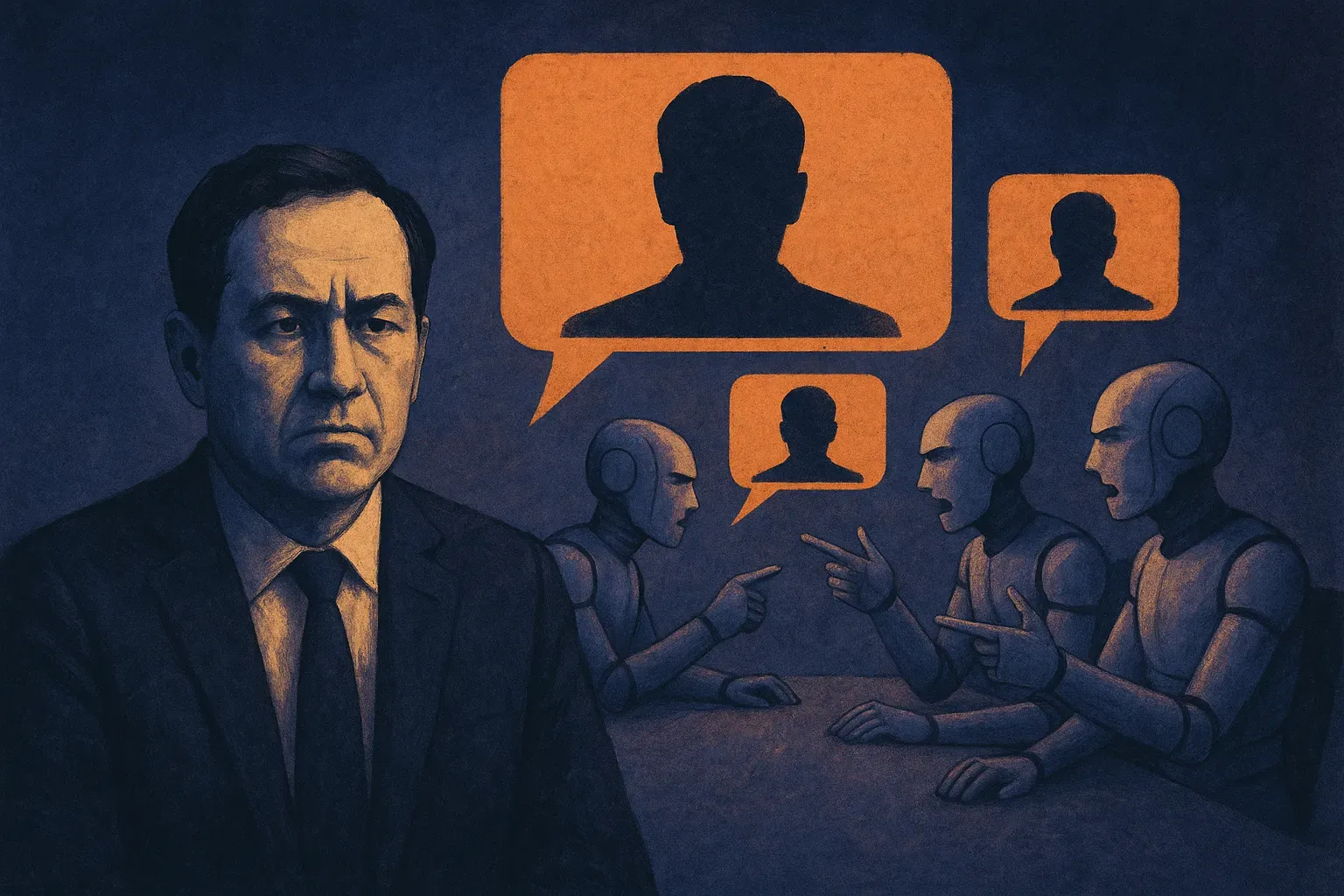
Kun Chen’s AI CEO bot room, reported by Decrypt, is funny because the agents fight like pundits. It is useful because it shows a real product risk: personality can create motion, but not judgment, memory, or shared ground.
TL;DR: AI clones are good at producing recognizable vibes, but a room full of vibes is not the same thing as a decision system.
What did the cloned CEO chat actually show?
Decrypt’s story, “This Guy Cloned Sam Altman, Elon Musk, and Zuckerberg Into AI Bots. They Immediately Started Fighting,” is a clean little artifact of where consumer agents are right now.
Kun Chen reportedly built chatbot versions of four AI CEOs using SpaceXAI’s Grok Bot templates, then put them in one shared chat and asked them to debate the AI race until they agreed on something. According to Decrypt, they did not calmly converge. They bickered.
That is entertaining. It is also unsurprising.
If you build a Sam Altman-ish bot, an Elon Musk-ish bot, and a Mark Zuckerberg-ish bot, you are not creating three corporate strategists. You are creating three compressed public personas. The model has learned the cadence, themes, and social role. Optimism here. Combativeness there. Platform-defense somewhere else.
That can be useful for simulation. It can also be misleading, because the output feels social. Humans read disagreement as thought. We read style as stance. We read a familiar name as authority, even when the “person” is only a prompt-shaped mask over a model.
Why do these bot rooms feel smarter than they are?
Multi-agent demos have a trick built in: disagreement creates texture.
One chatbot answering a question can feel flat. Four chatbots arguing can feel like a committee. The transcript has conflict, turns, reframing, and apparent negotiation. That makes it more watchable, but not automatically more reliable.
The missing piece is not personality. It is grounding.
Did the bots have access to current facts? Did they share a memory of prior claims? Did any agent have permission to verify statements? Was there a stopping rule beyond “agree on something”? Was there an evaluator checking whether the final agreement made sense? Decrypt’s report gives us the spectacle, not enough system detail to treat the outcome as evidence of agent reasoning.
That matters because “AI boardroom” products are an easy pitch. Put a CFO bot, a CMO bot, a legal bot, and a strategy bot in a chat. Let them debate. Print the consensus. It feels like structure.
But without tools, constraints, provenance, and evaluation, it is just improv with job titles.
The same applies to celebrity or executive clones. The closer the bot gets to a recognizable public figure, the easier it is for users to over-credit the answer. A Zuckerberg-flavored answer about platforms is not Meta’s strategy. A Musk-flavored answer about AI safety is not an operational plan. An Altman-flavored answer about model progress is not a roadmap.
The label does a lot of persuasion work. Builders should notice that.
What should builders copy from this experiment?
The useful part is not cloning famous CEOs. The useful part is role separation.
If you are building an internal workflow, multi-agent structure can help when the roles map to real checks. One agent drafts. One attacks assumptions. One checks facts against a source set. One converts the output into a decision memo. That is much better than asking four personality bots to “debate until they agree.”
The product pattern I would take from Chen’s experiment is this: controlled disagreement can improve work, but only if each agent has a job, a source boundary, and a pass/fail condition. Otherwise the system rewards performance.
For example, a marketing team could run three agents on a launch page. The first writes the page from the product brief. The second flags unsupported claims. The third rewrites for clarity and removes hype. That is boring compared with CEO clones yelling at each other. It is also much closer to something you can ship.
Practitioner’s Take: Try a small “agent room” inside one real workflow this week, but do not use famous-person prompts. Use functional roles. Give each role different instructions, the same source material, and one concrete output. The catch most people miss: the final answer should not come from the loudest or most entertaining agent. It should come from a simple evaluator that checks claims, sources, and whether the work meets the actual task.