
South Korea’s reported free AI plan runs into compute math
Decrypt reports that South Korea plans free AI access for every citizen, backed by state-supplied Nvidia B200 chips. The interesting question is not whether “unlimited tokens” sounds generous. It is what public AI access looks like when compute, latency, identity, and governance all meet real demand.
TL;DR: South Korea’s reported free national AI access plan is best read as public compute infrastructure, not magic unlimited usage.
What is South Korea reportedly building?
Primary source for this note is Decrypt’s report, “South Korea Will Give Every Citizen Free AI Access With Unlimited Tokens.” Decrypt reported that South Korea will give every citizen free AI access with unlimited tokens, run by three consortia, using up to 512 Nvidia B200 chips supplied by the state. Beta testing is reportedly due in September.
That is a big claim. Also a very specific one. The phrase “unlimited tokens” will get the headlines, but the operator question is simpler: what kind of system can you run when national demand hits a finite cluster?
I have not seen a first-party government announcement in the supplied material, so I’m treating the rollout details as reported terms, not confirmed public program mechanics. That matters because pricing, eligibility, usage limits, model choices, identity requirements, logging, and safety rules are the whole product here. “Free AI access” can mean a basic chatbot portal, an API-like developer service, a school and public-sector assistant, or some mix of all three.
The strongest version is not “every citizen gets infinite GPT-class inference forever.” The stronger, more believable version is this: the state subsidizes access to frontier-ish or near-frontier AI capacity, spreads it across consortia, and uses public infrastructure to prevent AI access from becoming only a corporate subscription product.
That is worth taking seriously.
Can “unlimited tokens” be real?
At the user interface level, sure. A service can say users have unlimited tokens if it does not meter them by token count or charge them per prompt.
At the infrastructure level, no. Tokens still consume compute. B200 chips are powerful, but 512 chips shared across a national population is not an infinite pool. Even with batching, quantization, caching, smaller models, routing, and strict workload management, usage has to be shaped somewhere.
That shaping can be visible or invisible. Visible shaping looks like queues, lower priority during peak hours, context limits, file size caps, reduced model choices, slower responses, or fair-use enforcement. Invisible shaping looks like routing easy tasks to smaller models, caching common answers, cutting context behind the scenes, or switching quality tiers based on demand.
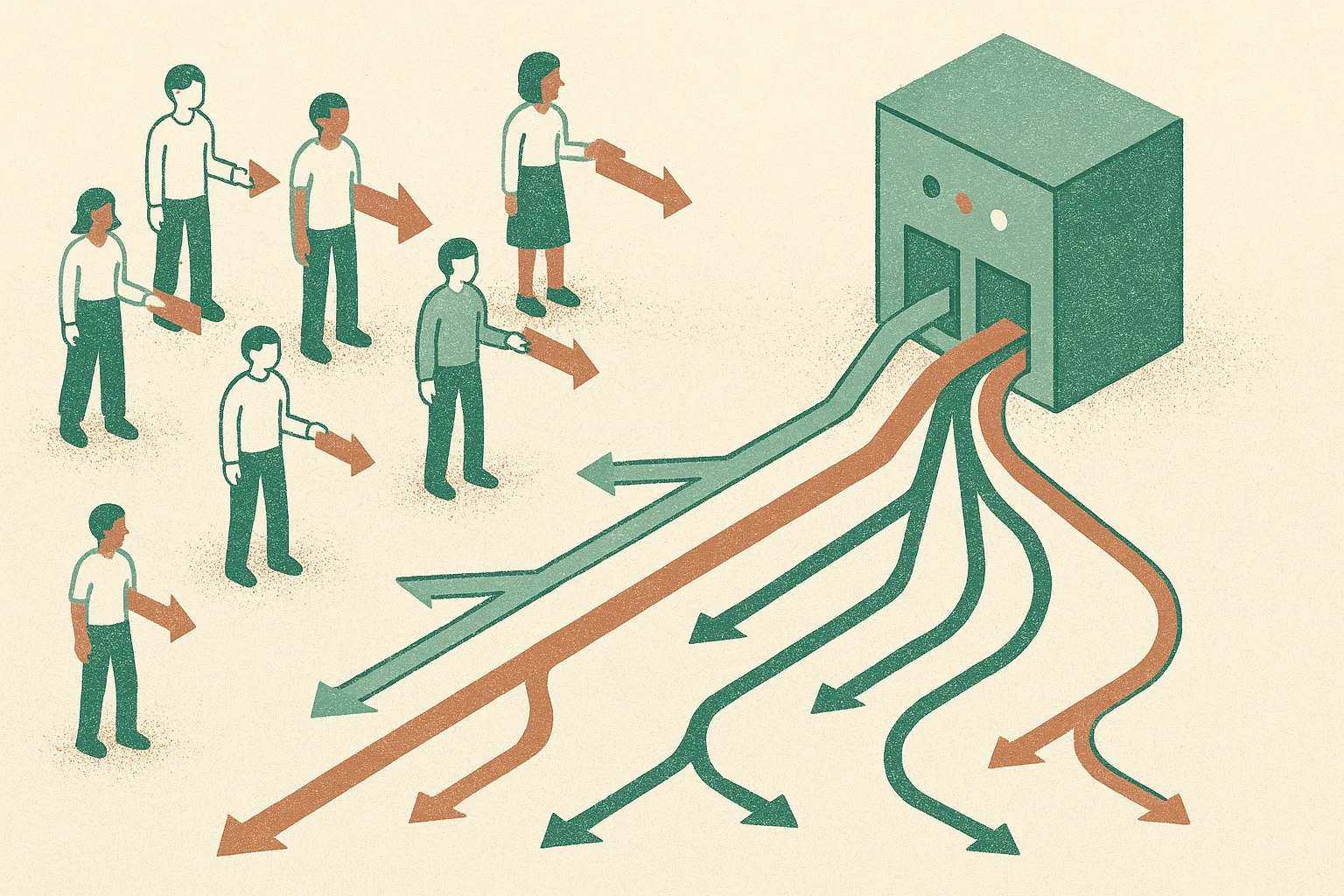
This is the catch with national AI portals. The policy promise is access. The engineering reality is allocation.
If South Korea is serious, the consortia design is interesting. Three operators may reduce single-vendor dependence and create room for different models, interfaces, and sectors. One consortium might focus on citizens. Another might serve education or small businesses. Another might handle public-sector workflows. Decrypt does not give those details, so I am not claiming that split. I am saying the architecture invites it.
The other hard part is abuse. A free, identity-backed national AI service has to decide what happens when users automate scraping, spam generation, political persuasion, homework outsourcing, cyber tasks, or mass document processing. Unlimited access without governance becomes a subsidy for the most aggressive users. Too much governance, and the service becomes a locked-down demo.
What should other governments copy?
Not the slogan. Copy the infrastructure idea.
Most countries are treating AI access as either a consumer app market or a procurement problem. Citizens buy subscriptions. Agencies buy pilots. Schools argue over cheating. Small businesses try to keep up.
A national AI access layer could be more useful than another innovation fund if it gives people practical capability: translation, form filling, tutoring, coding help, document search, small business support, benefits navigation, and local language assistance. The best public AI system may not be the smartest chatbot in the world. It may be the one that is available, cheap to run, good enough, and connected to the services people actually use.
But the metrics should be boring. Latency at peak time. Cost per useful task. Share of requests handled by small models. Accessibility. Korean-language quality. Uptime. Complaint handling. Data retention. Redress when the model gives bad guidance. Those receipts will tell us more than “unlimited tokens.”
For builders, the move is to watch this as a template for public AI distribution. If you serve education, civic tech, healthcare admin, local commerce, or government workflows, assume more countries will test subsidized AI access. Build products that can sit on top of constrained shared compute: route tasks by complexity, cache aggressively, keep human review for high-stakes steps, and design for identity and audit from day one. The catch most readers miss is that free access does not remove scarcity. It moves scarcity from the invoice to the scheduler.