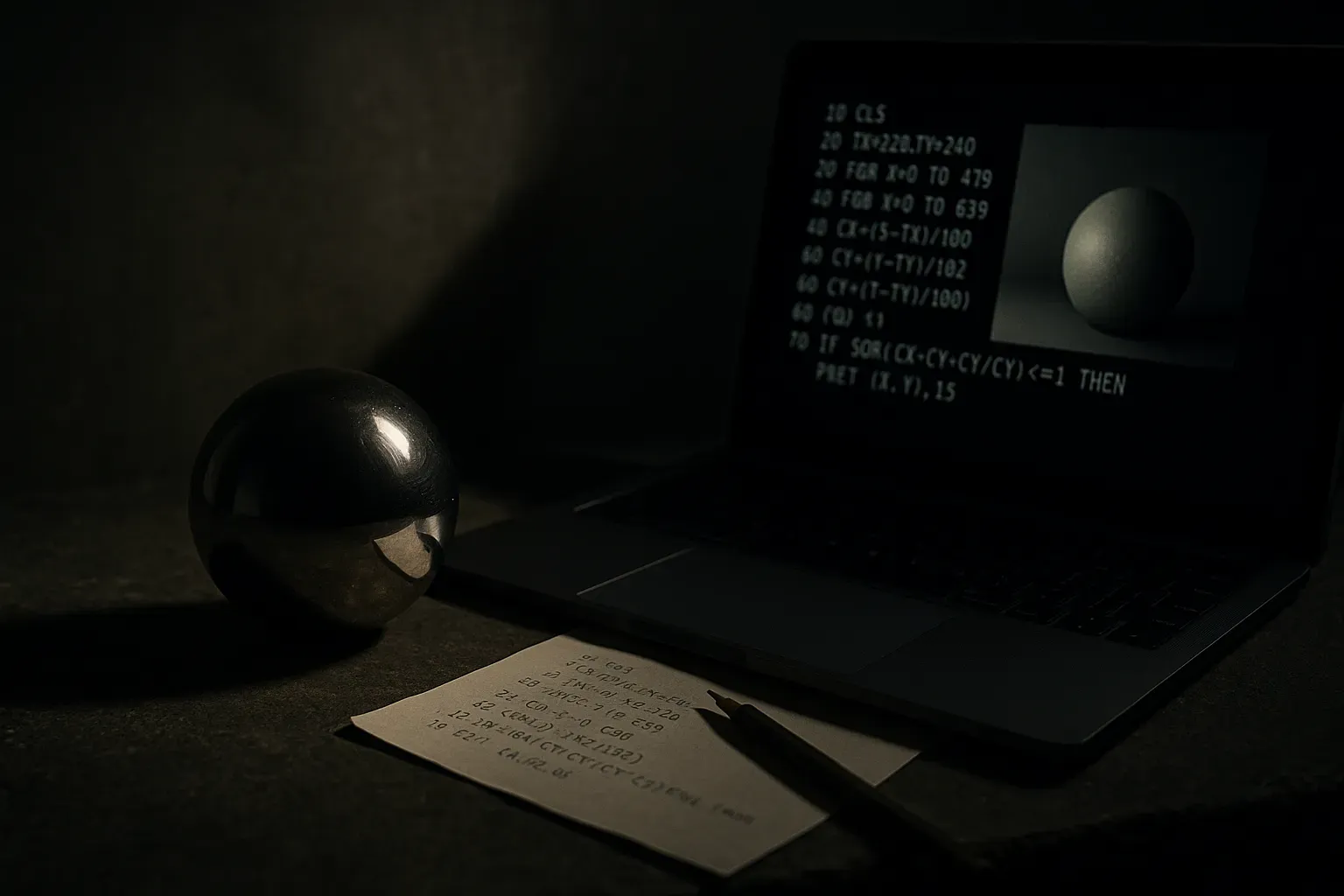
Qwen’s BASIC ray-tracer demo is really about closed-loop coding
A LocalLLaMA experiment comparing Qwen3.8-27B and Qwen3.6-27B on a BASIC ray-tracing task shows why visual feedback loops matter more than single-prompt coding demos.
TL;DR: The interesting part of this Qwen demo is not that a local model wrote a ray tracer, it is that the model got to run code, inspect the image, and fix its own mistakes.
What actually improved here?
The primary source is the r/LocalLLaMA post “Qwen3.8-27B vs Qwen3.6-27B writing ray-tracers in BASIC” by /u/Ok-Breakfast1878. It is not a benchmark paper. It is one builder’s hands-on comparison. That matters, because the claim is narrow but useful: in this user’s BASIC graphics harness, Qwen3.8-27B handled a recursive ray-tracing prompt much better than Qwen3.6-27B.
The prompt was specific and nasty in a good way: write a recursive ray-tracing demo that renders three metallic spheres, copper, silver, and gold, over a glossy checkerboard plane under a deep blue sky, using the Cook-Torrance model. That is not a CRUD app. It tests geometry, rendering concepts, code generation, and visual self-correction.
According to /u/Ok-Breakfast1878, Qwen3.6-27B could get there with user help, but often missed visual errors and failed to fix them unless prompted again. Qwen3.8-27B “typically knocks it out of the park on its own,” iterating to a good result. Both were reportedly running Unsloth UD-Q8_K_XL quants.
That is the useful signal. Not “Qwen3.8 is better at everything.” Not “local models have solved coding.” A more grounded read: for this visual programming loop, the newer 27B model seemed more capable at noticing and repairing output defects without a human nudge.
Why does the harness matter more than the prompt?
The harness is the real story. /u/Ok-Breakfast1878 described an agentic setup with a BASIC-to-JavaScript transpiler in a web page. The agent writes BASIC, runs it, examines the resulting images, then iterates.
That changes the task from “generate code from a prompt” to “operate a tiny software lab.”

This is where many coding demos mislead people. A single-shot prompt rewards models that produce plausible-looking code. A closed loop rewards models that can compare intention to result. For visual programs, that is huge. If the reflection looks wrong, the shadow is missing, or the spheres are not metallic, the model needs to map pixels back to code changes.
That is harder than passing a unit test in some ways, because the failure is fuzzy. There may be no red stack trace. The output can be “almost right,” which is exactly where many agents stall. They need taste, domain concepts, and a repair strategy.
This also explains why small improvements in model behavior can feel large in practice. If one model needs three human interventions and another needs zero, the wall-clock experience is not 10 percent better. It is a different workflow.
What should builders take from this?
I would not treat a Reddit graphics demo as a leaderboard. It has no controlled eval set, no repeated scoring protocol, and no comparison across model families. The source is valuable because it captures something many formal coding benchmarks miss: whether a model can use feedback in a live artifact loop.
That is where local models are getting interesting. A 27B quant running locally does not need to beat the best frontier model on every benchmark to be useful. It needs to be good enough inside a tight tool loop, especially where privacy, latency, cost control, or offline use matter.
The catch is that “agentic harness” is doing a lot of work. Without execution, inspection, and iteration, the same model may look much less impressive. The scaffold is not decoration. It is part of the system’s intelligence.
For builders, the practical move is simple: stop testing coding models only with static prompts. Pick one artifact your product actually cares about, a rendered image, generated report, spreadsheet, SQL result, UI state, or simulation output. Give the model a way to run it, inspect it, and revise it. Then compare models by human interventions needed, not vibes. The catch most people miss: the best model for your workflow may be the one that fails visibly and recovers cleanly, not the one that writes the prettiest first draft.