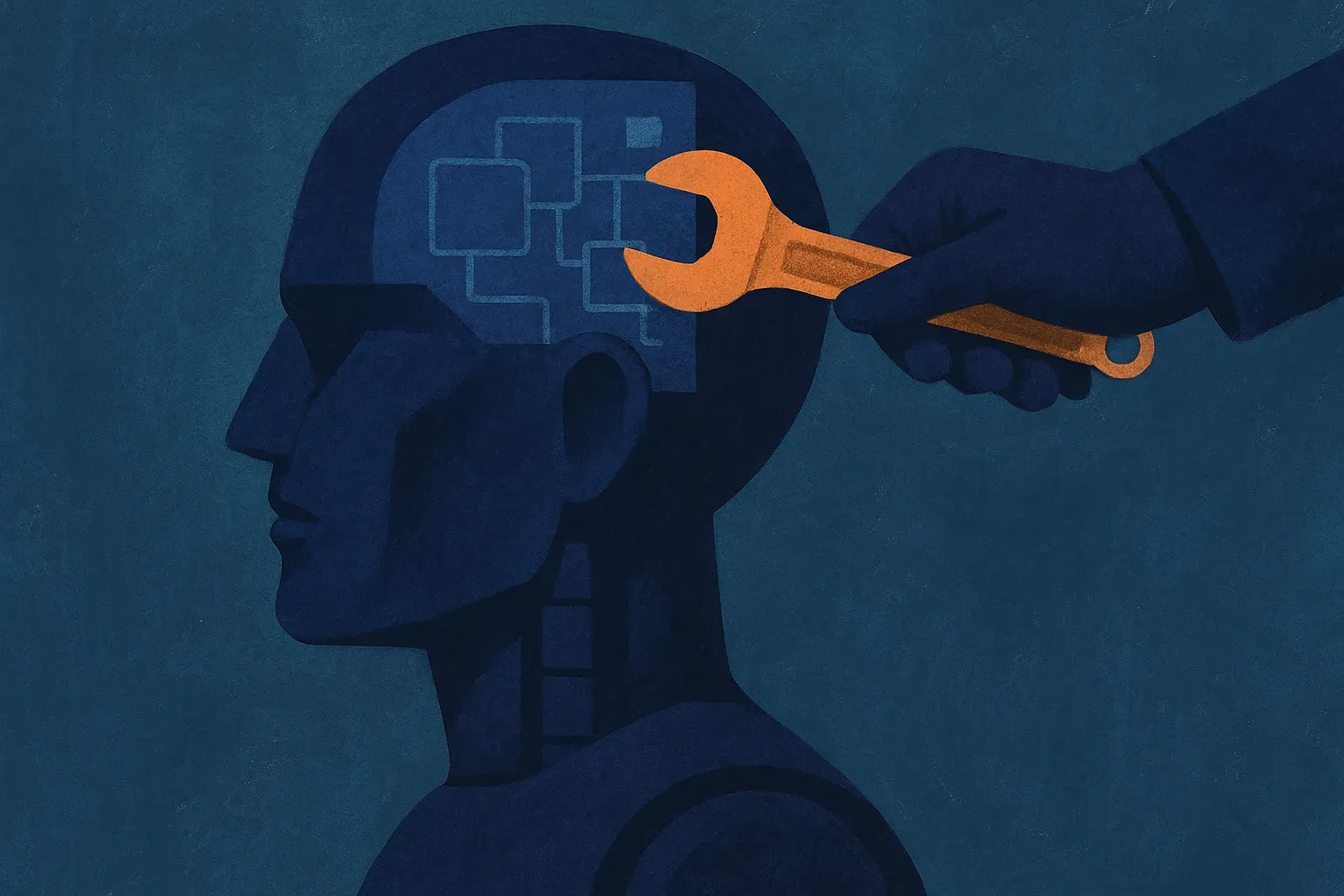
Alignment baked into pretraining, not bolted on later
Synthetic Persona Pretraining argues that assistant values should be introduced during pretraining, not just after it. The result is promising at 3B parameters, but the real question is whether persona binding survives scale, messy data, and product incentives.
TL;DR: “Synthetic Persona Pretraining: Alignment from Token Zero” makes a useful alignment bet: teach the model the assistant persona during pretraining, then bind that persona during post-training, instead of hoping late-stage alignment can overwrite everything.
What changes if alignment starts at token zero?
Most assistant alignment today is late-stage work. Pretrain a base model on a huge mix of internet text, code, books, and whatever else made the cut. Then use instruction tuning, preference optimization, constitutions, safety data, and policy filters to make it act like a helpful assistant.
The arXiv cs.AI/cs.CL paper “Synthetic Persona Pretraining: Alignment from Token Zero” argues that this is backwards, or at least incomplete. If the model’s behavioral priors are formed during pretraining, then adding the assistant identity afterward can become a thin overlay. It may work in normal chat. It may fail under pressure.
The proposed method, Synthetic Persona Pretraining, or SPP, changes the training mix itself. Pretraining documents get annotated with synthetic first-person reflections derived from a normative value constitution. The model is then trained with the normal cross-entropy objective on both the original documents and those value-aligned reflections. Later, post-training on user-assistant dialogue data “binds” the desired persona to the assistant identity.
That last step matters. The paper reports that SPP’s advantage depends on persona binding. Without binding, the values may exist somewhere in the model’s learned distribution, but not reliably as the thing that answers when a user says, “you.”

Did it actually improve behavior?
Within the experiment, yes.
“Synthetic Persona Pretraining: Alignment from Token Zero” reports experiments up to 3B parameters and 500B tokens. The paper says SPP improved constitution following and jailbreak robustness, reduced misalignment in out-of-distribution moral dilemmas, and preserved capabilities.
The most interesting result is not just “SPP helped.” It is the timing comparison. Introducing SPP only at the end of pretraining produced weaker constitution adherence, did not shift value priorities, and led to less aligned choices in moral dilemmas. The paper also reports that the advantage increases with pretraining budget.
That is the core claim worth watching. If true at larger scale, alignment may become less like finishing work and more like architecture, data curation, and training-time identity design.
But this is not a solved-alignment headline. The experiments top out at 3B parameters, small compared with frontier systems. The values come from a normative constitution, which means the hard political and product question moves upstream: whose constitution, written how, audited by whom, and updated when? Synthetic reflections may also teach a model to talk like it has values. The paper reports behavioral gains, not proof of inner intent.
Still, the framing is practical. A lot of jailbreak work treats misbehavior as something to patch at the interface. SPP treats some of it as a training distribution problem.
What should builders take from this?
For most teams, pretraining from token zero is not on the menu. You are not casually running 500B-token experiments before lunch. But the lesson travels.
If you are fine-tuning or adapting open models, stop treating “persona” as a system prompt only. The model should see the behavior you want across training examples, tool calls, refusals, edge cases, and recovery paths. The assistant identity should not appear only in the final chat template. If your product needs a careful medical intake assistant, a strict compliance reviewer, or a patient tutoring agent, that identity needs repeated grounding in the data, not just a paragraph at the top of the prompt.
The catch is that stronger persona binding is not automatically good. It can make good behavior more stable. It can also make bad assumptions more stubborn. If you bind a vague, overconfident, brand-safe persona into the model, you may get a model that refuses awkwardly, flatters users, or hides uncertainty with more consistency.
For a builder, the move is small but concrete: write down the constitution your assistant is actually supposed to follow, generate training examples that show first-person reasoning consistent with it, then test against cases outside the training distribution. Do not only test happy-path prompts. Try role pressure, conflicting goals, tool misuse, and moral ambiguity. SPP’s big idea is early identity shaping. The practical version is this: do not wait until the system prompt to decide who your model is.