Heart-failure feature engineering gets an agent pipeline, not a chatbot
The Nimblemind heart-failure paper is a useful signal for clinical AI builders: the win is not replacing experts with LLMs, it is turning messy EHR reasoning into auditable, evidence-linked feature pipelines.
TL;DR: The practical AI opportunity in clinical data is not a free-form medical chatbot, it is an auditable agent pipeline that turns fragmented records and guidelines into traceable features.
What did Nimblemind actually build?
The primary source here is the arXiv cs.AI/cs.LG paper titled “Tracing the Heart: An Evidence-Linked Pipeline for Heart-Failure Feature Engineering.” It reports on the Nimblemind Multi-Agent System, or nMAS, built for heart-failure feature engineering from electronic health records.
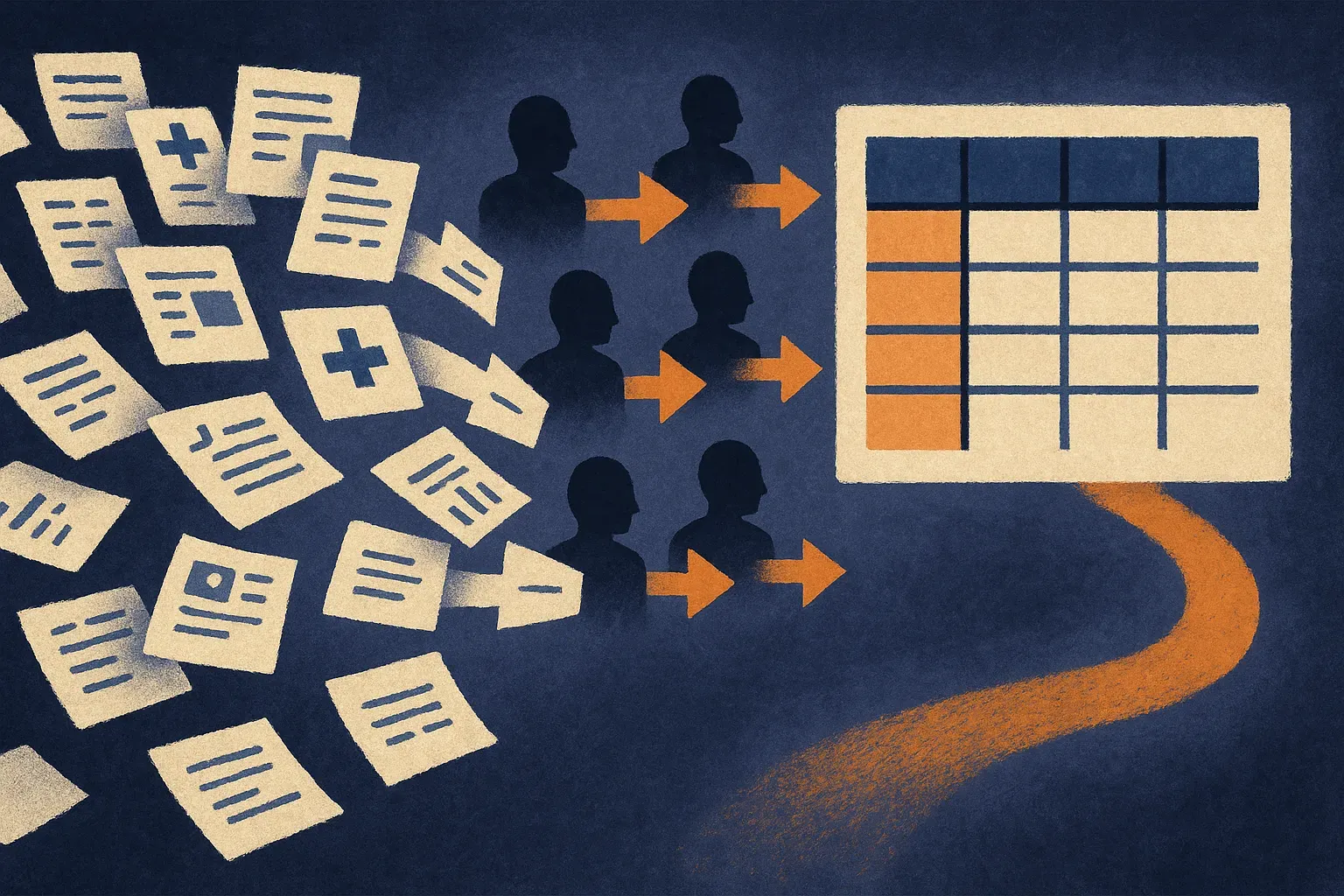
That framing matters. This is not a model claiming to diagnose patients from vibes. It is a pipeline for a slower, less glamorous, very real bottleneck: feature engineering. The paper says EHR feature engineering accounts for 39-45% of data scientists’ workload. In heart failure, the work is worse because the relevant signal is scattered across source tables, clinical events, medication history, lab values, procedures, and guideline logic.
nMAS was evaluated on 500 dummy patient records from nine EHR source tables. It generated 132 structured features and 70 rubric-scored aggregated features. The system checked structural integrity, rubric compliance, and provenance, then used a restricted LLM for auditing.
That is the interesting part. The LLM is not just being asked, “What does this patient have?” It is being boxed into a workflow with evidence links, rubrics, and verification. Less magic. More paperwork. In medicine, that is a compliment.
Why does this matter for heart failure phenotyping?
Heart failure affects an estimated 6.7 million U.S. adults, and the labels are not simple. The paper focuses on HFrEF and HFpEF phenotyping, two categories that require more than one field in a database. A useful feature may combine ejection fraction, medications, labs, timing, and clinical context.
The reported gains are large enough to pay attention to, with caveats. Adding the aggregated nMAS features improved held-out AUROC from 0.895 to 0.963 for HFrEF and from 0.870 to 0.910 for HFpEF. An independent LLM-based rubric assessment scored the generated features at 81.5% of maximum points for evidence support and methodological soundness.
I would not read that as “agents solved clinical AI.” The evaluation used 500 dummy records, and the paper itself says external validation is needed. It also notes the work was limited to a single-institution cohort. That is a real constraint because EHR schemas, documentation habits, coding practices, and local clinical workflows vary a lot.
Still, the direction is useful. The system is not trying to skip clinical reasoning. It is trying to encode it, score it, and leave a trail.
What is the real lesson for AI builders?
The lesson is architecture, not model choice.
A lot of AI product demos in healthcare still look like a chat window pasted onto sensitive data. That is rarely enough. The nMAS design points toward something more practical: agents with bounded jobs, evidence requirements, rubrics, checks, and an audit pass. The output is not a paragraph. It is a feature set that a downstream model can use and a human can inspect.
That pattern travels beyond cardiology. Claims processing, safety review, pharmacovigilance, trial matching, compliance monitoring, and internal analytics all have the same shape: messy source systems, domain rules, partial evidence, and a need to explain how an answer was produced.
The catch is maintenance. Evidence-linked pipelines sound clean until guidelines change, source tables drift, local codes mutate, and edge cases pile up. The hard product work is versioning rubrics, tracking provenance, testing changes, and keeping clinicians in the loop without making them babysit every row.
For a builder, I would try this on one narrow workflow with known expert disagreement and painful manual feature work. Pick a small set of source tables. Define the rubric before touching the model. Require every generated feature to carry provenance. Then compare against your current manual workflow on quality, time saved, and failure modes. The missed catch: the LLM is not the product. The evidence trail is.