
AdaPrefix-GRPO turns hard reasoning failures into training signal
A new GRPO training method uses adaptive solution prefixes as a difficulty dial, keeping hard reasoning problems near the point where policy gradients are most useful, then removes the help before deployment.
GRPO has a funny failure mode. It learns from contrast. If one rollout solves a problem and another fails, the optimizer has something to push on. If every rollout fails, the group has no useful relative advantage. The hardest examples become dead weight.
That is exactly the waste you do not want in reasoning training. The frontier examples are expensive, interesting, and often the ones that separate a toy math model from a useful one.
A new arXiv paper, cross-listed in cs.CL and cs.LG, proposes AdaPrefix-GRPO, a simple fix with a good operator smell: give the model part of the correct reasoning trace when it is stuck, then slowly take that help away.
The trick is not the prefix. It is the feedback loop.
Other curriculum-style methods can prepend a fixed chunk of a reference solution. That makes the problem easier. Fine. But a fixed setting is crude, because the right amount of help changes during training and differs by problem.
AdaPrefix-GRPO treats prefix length as a control knob. During training, each problem gets enough of the reference trace to keep success near 50%. That is the sweet spot for GRPO, according to the paper, because the group now contains a useful mix of wins and losses. Not all failure. Not all success.
Then the controller withdraws the prefix. At deployment, the model solves the problem unaided.
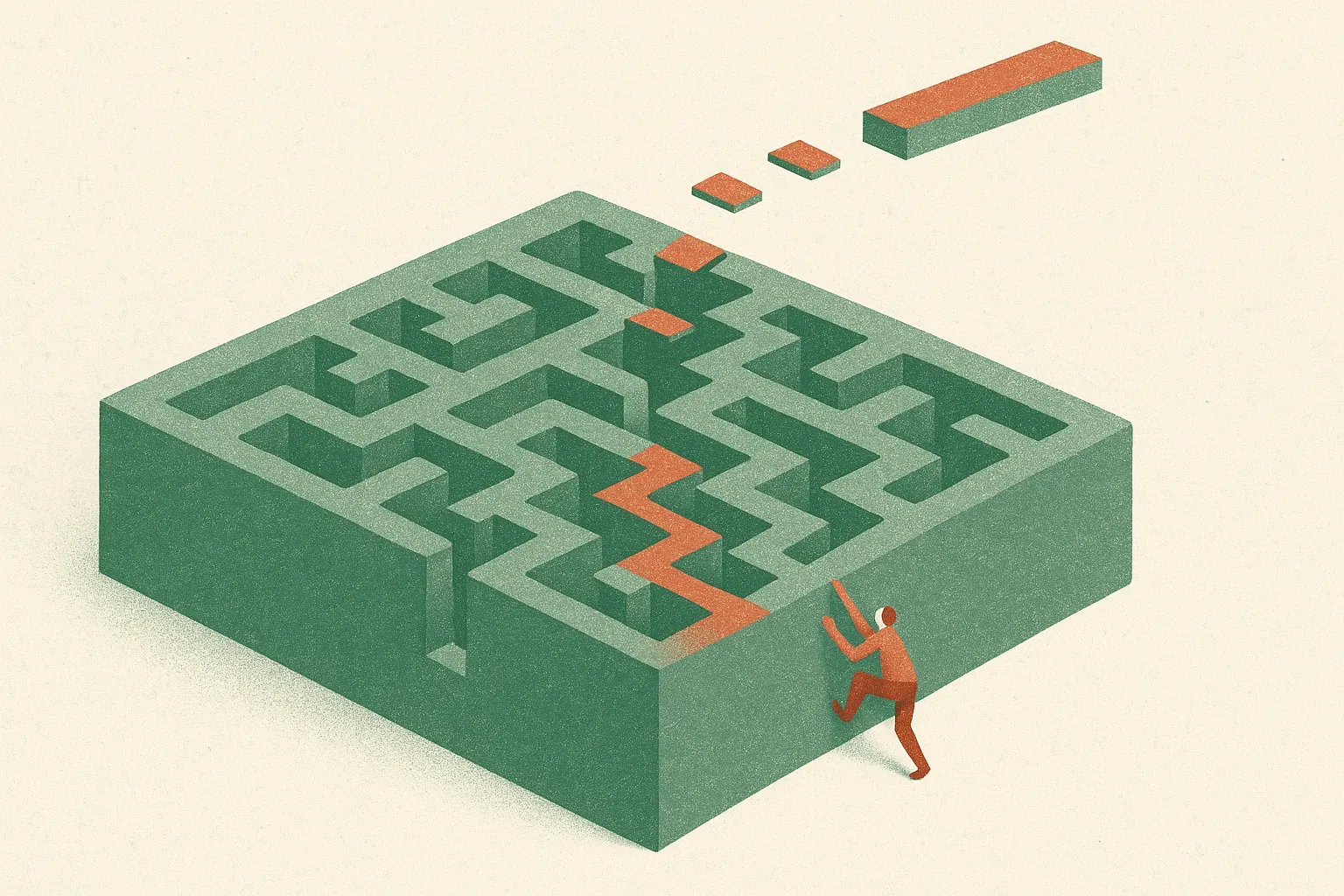
The important detail: this is not a new trainer. The authors describe it as data preparation plus a loss mask on the prefix tokens. The model is not rewarded for copying the given part of the trace. The stock GRPO machinery still runs. That matters, because training hacks that require a custom RL stack often die before anyone outside the lab can use them.
The reported gains are strongest where you would want them
The AdaPrefix-GRPO authors report large improvements on hard math at matched training FLOPs. For a 0.6B model, accuracy on held-out problems from the training distribution more than doubled, a 2.1x gain over GRPO. On Qwen3-1.7B, the gain was 1.6x. On AIME, they report 1.7x.
They also report roughly halving trace length. That is a nice second-order win. Shorter reasoning traces are not automatically better, but if accuracy rises while traces shrink, the model may be learning a cleaner path rather than just spraying tokens until something works.
The smaller-model result is the one I would watch. The paper says smaller models benefit more. That makes intuitive sense. A 0.6B model is more likely to see hard problems as a wall of all-fail rollouts. Give it a partial foothold and it can finally produce differentiated attempts. Larger models already get more natural successes, so the intervention has less room to help.
This is curriculum learning with a measurable target
I like this because the target is operational. “Make training examples appropriately difficult” is vague. “Hold rollout success around 50%” is something you can instrument.
Still, there are catches. AdaPrefix-GRPO needs reference solutions with usable reasoning traces. That is cheap in some math settings and much harder in messy real-world agent tasks. It also assumes the verifier or reward signal can reliably tell success from failure. If your reward is noisy, the controller may tune the wrong thing.
There is also a generalization question. The reported numbers are for hard math, including held-out problems from the training distribution and AIME. That is meaningful, but not proof that adaptive prefixes will help every reasoning domain. Code repair, tool use, theorem proving, and multi-step web tasks may need different notions of “prefix” and different ways to withdraw assistance.
For builders, the practical idea is simple: stop feeding RL systems examples that are either impossible or already solved. If you have reference traces, turn them into adjustable scaffolds, mask the scaffolded tokens from loss, and track per-problem success rates during training. The catch most people will miss is the withdrawal step. If the help stays on, you trained a dependent model. The useful version is the one that learns while the crutch is disappearing.