
Hugging Face Kernels: The Case for Shipping GPU Code Like Python Packages
Hugging Face is pushing a model where optimized GPU kernels get downloaded and cached like any other dependency, which could reshape how builders access performance without owning a compiler toolchain or a research team.
The unglamorous truth about running models fast is that most of the speed lives in kernels. Not the model architecture, not the framework, not the prompt. The tight, hardware-specific chunks of GPU code that do the matrix math. And for years those kernels have been locked behind a wall: you either had a team that could write CUDA, or you took whatever your framework shipped and hoped it was good enough.
Hugging Face’s latest Kernels updates are an attempt to knock that wall down. The pitch is simple enough that it sounds obvious in hindsight. Treat kernels like packages. Download them, cache them, version them, share them. Let someone else write the fast code and let you just call it.
I’ve watched a lot of “democratize performance” claims come and go. This one is worth paying attention to, because the distribution mechanic is the actual innovation, not the kernels themselves.
What Hugging Face is actually shipping
The core idea in the Kernels project is that a kernel is an artifact you can fetch from the Hub, the same way you’d pull a model or a dataset. Instead of compiling attention kernels or quantization routines yourself, you reference them and the library handles resolving the right build for your hardware and your PyTorch version.
That last part matters more than it reads. The historical pain of GPU code isn’t writing it once. It’s the combinatorial mess of CUDA versions, PyTorch versions, GPU architectures, and Python ABIs. A kernel that screams on an H100 with one toolchain can fail to load entirely on a different setup. The Kernels approach is to precompile across that matrix and let the client pick the matching binary at runtime.
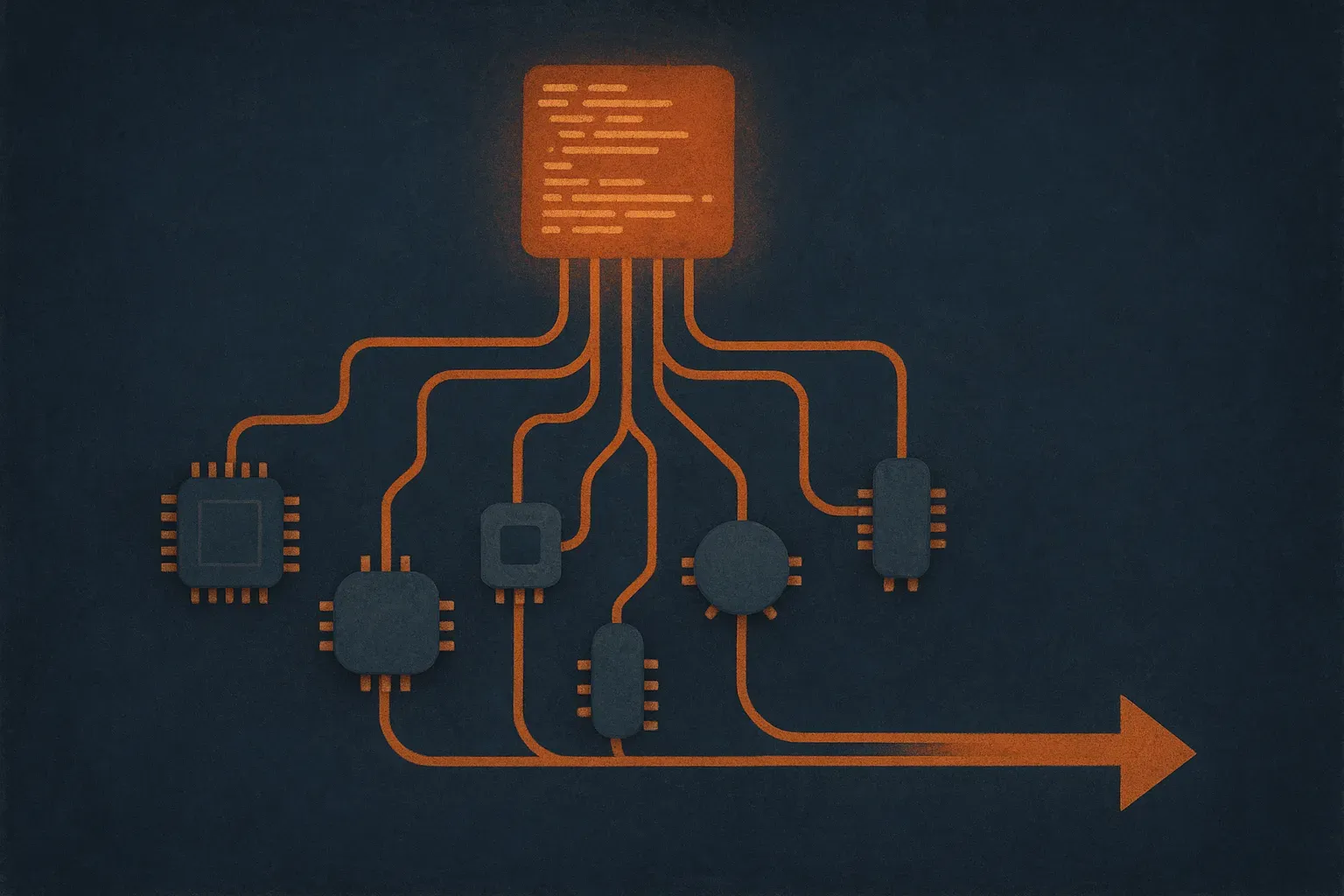
So the mental model is: kernel authors publish once against many targets, and consumers get a single call that resolves to the right one. If you’ve ever spent a Friday fighting a undefined symbol error deep in a compiled extension, you understand why this is more than a convenience feature.
Why the distribution layer is the real story
Everyone can write a fast kernel eventually. The bottleneck has never been raw capability. It’s been the gap between “a kernel exists” and “the kernel exists in a form I can actually use without a build environment.”
Think about how PyPI changed Python. The language didn’t get better because of pip. What changed was that sharing code stopped being a research project. You published a wheel, someone typed pip install, and it worked. The friction dropped to near zero, and an ecosystem grew on top of the low friction.
Kernels is trying to do that for GPU code. The interesting downstream effect is who gets to participate. Right now, kernel optimization is concentrated in a handful of labs and vendors: NVIDIA, a few frontier model companies, some specialized shops. If distribution becomes trivial, a researcher who writes one excellent fused kernel for a niche operation can ship it to everyone, and the value of that work compounds instead of dying in a repo nobody can build.

That’s the optimistic read. The honest caveat is that a shared registry is only as good as the trust and quality inside it. Model weights on the Hub already come with supply-chain questions. Binary GPU kernels raise the stakes, because you’re pulling compiled code that runs with a lot of privilege on your accelerator. “Download and run a precompiled binary from the internet” is exactly the sentence security teams have spent two decades trying to eliminate.
The parts I’d want spelled out before I trust it
Hugging Face’s framing is about ease and reach, which is the right thing to sell. But I’d want three things nailed down before I put this in a serious pipeline.
First, provenance. Who built this binary, from what source, with what compiler, and can I verify that independently? Reproducible builds and signing aren’t nice-to-haves here. They’re the difference between a package registry and a malware vector.
Second, fallback behavior. When no matching kernel exists for my exact hardware and version combo, what happens? A graceful drop back to a reference implementation is fine. A hard crash in production is not. The whole appeal of the abstraction collapses if the failure modes are worse than compiling myself.
Third, performance transparency. A kernel being available doesn’t mean it’s fast on my workload. Attention kernels in particular are shape-sensitive: the winning implementation at a batch size of 1 is often not the winner at 256. Without benchmarks tied to actual configurations, “here’s a fast kernel” is a claim, not a measurement.
None of these are reasons to dismiss the project. They’re the questions that separate a useful tool from a demo.
Where this fits in the bigger performance picture
Zoom out and there’s a clear direction of travel across the whole stack. Compilers like torch.compile, kernel languages like Triton, and now a distribution layer for compiled kernels are all chipping at the same problem from different angles: getting hardware-level speed to people who can’t or shouldn’t write hardware-level code.

The endgame most builders actually want is boring. You write normal model code, and the fast path just happens underneath you, resolved automatically, updated when someone upstream finds a better implementation. Kernels-as-packages is a real step toward that, precisely because it treats speed as a shared resource instead of a private moat.
I’m genuinely optimistic about the shape of this. I’m also aware that “shared registry of compiled code” is a promise that has to earn trust every single day, and the first time a poisoned kernel ships, the whole model gets a much harder look.
The practical move right now: if you’re serving models and you’ve been eating whatever kernels your framework ships, spend an afternoon seeing whether a Hub-sourced kernel beats your baseline on your real traffic shapes, not on a synthetic benchmark. Measure it yourself, pin the exact version you validated, and don’t let it auto-update in production. The value here is real, but it’s the value of a dependency, and you should treat it with the same discipline you’d give any other dependency that runs privileged code on your hardware. The catch most people will miss is that “faster” is workload-specific, so a kernel that wins a leaderboard can still lose on your batch sizes. Trust the number you generated, not the one someone else did.