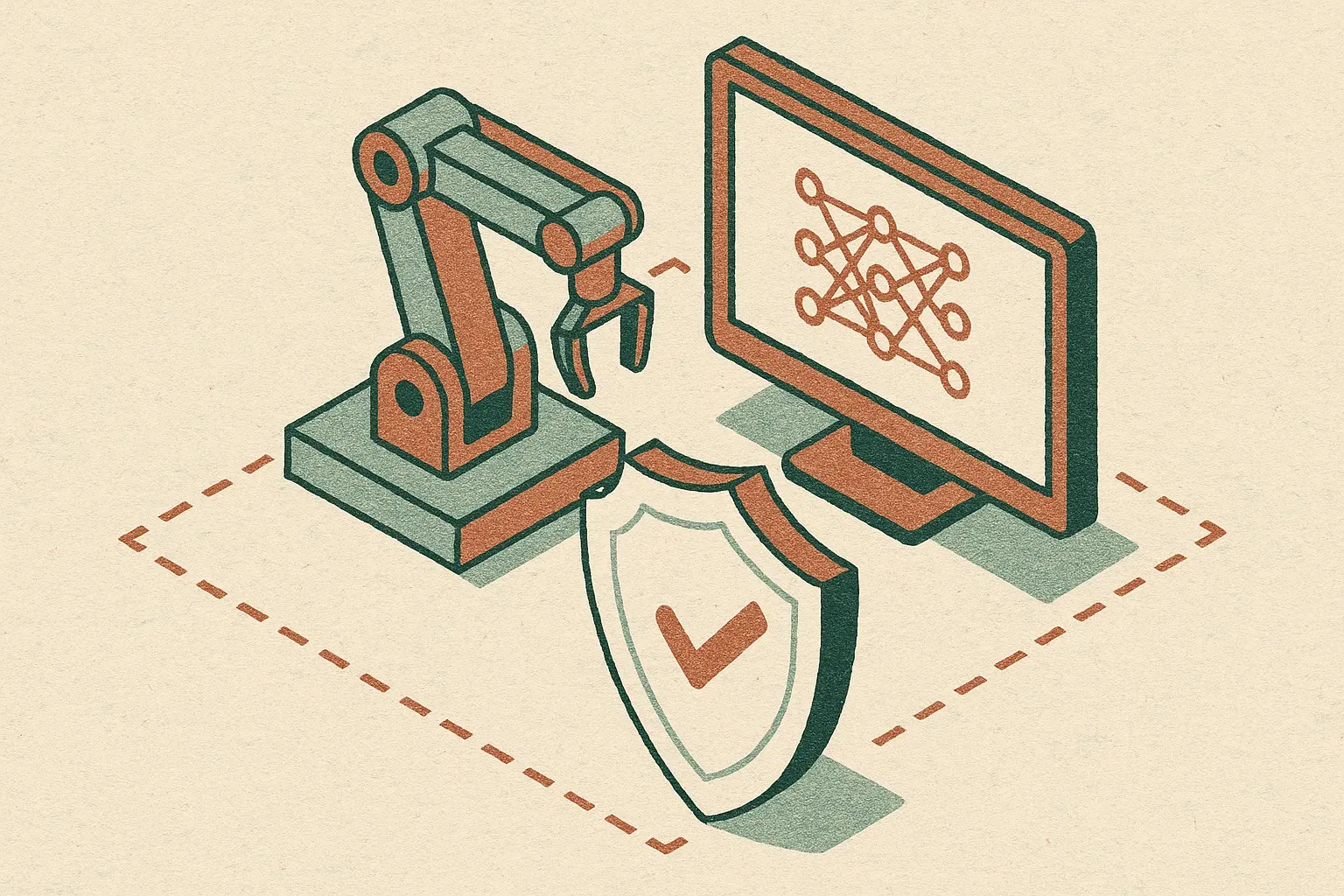
GPUSLS-LEO brings verification closer to real-time control
A new arXiv control paper points at a practical middle path for neural dynamics: keep fast linear approximations, but put certified error bounds around them so planners can run online without pretending the approximation is exact.
The interesting part of GPUSLS-LEO is not that it uses a GPU. Lots of things use a GPU now. The useful claim is narrower: a controller can plan against nonlinear or neural network dynamics in real time while carrying certified bounds on the error introduced by linearizing those dynamics.
That matters because linear time-varying approximations are the workhorse move in control. You take a messy nonlinear system, approximate it locally with something tractable, then solve the planning problem. The catch is obvious and often underpriced: the approximation is wrong. If the robot, drone, vehicle, or learned simulator is operating near constraints, “close enough” can become “hit the wall.”
The GPUSLS-LEO authors report a method that computes tight, differentiable linearization error bounds, then feeds them into a GPU-parallel system-level synthesis solver. On systems up to 168 state dimensions, they report online policy computation up to 67 Hz. That is the receipt worth paying attention to. Not a benchmark about vibes. A frequency number tied to formal reachable tubes.
The approximation is the product risk
A lot of applied AI work treats learned dynamics as a drop-in replacement for physics. Train a model, roll it forward, let a planner query it. That can work in forgiving environments. It is much less satisfying when the planner needs to prove it will stay inside constraints.
This paper attacks the gap between “the neural model predicts well” and “the controller can trust the model enough to act.” For analytic dynamics, the authors use path-based Hessian bounds, which they say are tighter than standard interval methods. For neural network dynamics, they use verifier-generated affine relaxations plus local Jacobian corrections to produce certified linearization error bounds.
That second part is the more AI-native move. Neural networks are not just black boxes here. They are objects you can bound locally with verifier tools, then fold into a control pipeline. The model stays useful, but the planner is not asked to pretend it is exact.

Fast enough changes the design space
Formal methods often lose builders at runtime. If the guarantee arrives after the system needed to act, it is a paper guarantee. GPUSLS-LEO is trying to move these checks into the control loop.
The authors adapt a GPU-parallel LTV-based system-level synthesis solver so it can handle right-invertible disturbance matrices and non-zero-centered disturbance sets. That sounds like control jargon, because it is. The practical point is simpler: tighter uncertainty propagation means less needless conservatism. If your uncertainty tube is too fat, the controller freezes, avoids useful maneuvers, or fails to find a plan. If it is too thin, the guarantee is fake.
This is the recurring trade in safe autonomy: speed, conservatism, and proof. Pick two, usually. The claim here is that better linearization error bounds, computed in parallel, let you keep more of all three.
I would not read this as “neural network controllers are solved.” The paper’s abstract does not tell us how painful the setup is, how verifier cost scales across architectures, or how well the method behaves when the learned dynamics are trained on poor coverage. Those are the parts that bite in real deployments. But the direction is right. Instead of making the model bigger and hoping planning gets easier, make the approximation accountable.
For builders, the useful pattern is: keep the fast local planner, but attach an explicit error accounting layer between the learned dynamics and the control action. Try this first in a constrained simulator with known failure modes, not on a live robot. Compare three runs: no bounds, loose interval-style bounds, and certified local bounds. The catch most teams miss is that the guarantee is only as useful as the modeled disturbance set. If your real uncertainty is outside the tube, the math is clean and the system is still wrong.