
Going All In on AI: My 8-Week Build Sprint
Why I'm dedicating 20 hours a week for the next eight weeks to nothing but building with AI, and documenting every step here.

Yesterday I made a decision: I’m going all in on AI.
Not on AI engineering. That’s not where I’m headed.
In her book AI Engineering, Chip Huyen describes the AI engineering stack as having three layers: application development, model development, and infrastructure. I’m focused on the top layer, application development. That’s the part anybody can do today, using the models that already exist. It’s about giving a model good prompts and the right context to produce real, usable results.
And honestly, that’s what makes this moment so exciting. You don’t need to train models or build infrastructure to create something useful. Anybody can pick up the tools and start building. That’s the part I plan to live in.
The space is moving fast. I believe we’re heading toward a future where everyone will need to know how to leverage AI, and I’d rather be early than have to catch up later.
The plan: 20 hours a week, 8 weeks
For the next eight weeks, I’m dedicating 20 hours a week to AI, with a deliberate balance.
The priority is building. Most of that time goes into actually using the tools, shipping projects, breaking things, and iterating. That’s where the real learning happens.
Alongside the building, I’m doing two things to keep the foundation solid:
Taking a class (more on that below)
Reading AI Engineering by Chip Huyen
The reading and the class are supplemental, but they’re not optional. Building without context produces shallow skills; theory without building produces no skills at all. I want both.
I’m also fortunate to be at a point in my business where I can step back briefly and invest this kind of time into developing new skills. That window doesn’t come around often, and I don’t want to waste it.
Why I’m documenting it here
I’m going to document the entire process on this Substack: the wins, the failures, the projects, and the lessons along the way.
Two reasons for that:
Sharing the journey. If anything I do here helps someone else figure out their own path into building with AI, that’s a great outcome.
Solidifying my learning. Writing forces me to slow down, review what I did, and actually understand it. The act of documenting is part of the learning itself.
Where I’m starting from
I’m not starting at zero. I’ve been prompting AI extensively for a while now (from work projects to planning vacations), and I’ve taken a couple structured AI courses through Maven, which has been my go-to platform for this kind of learning.
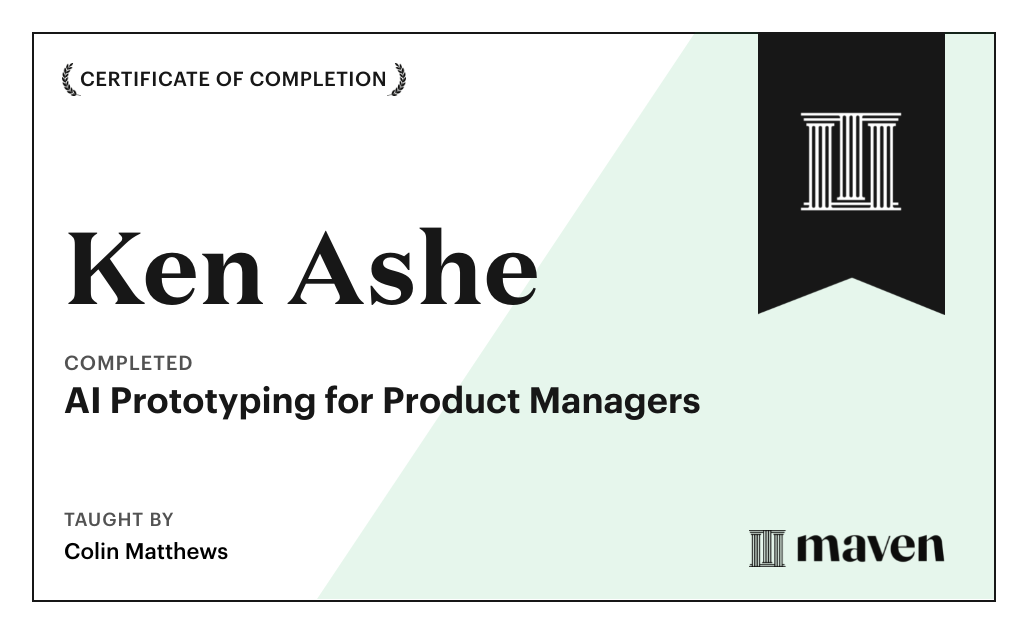
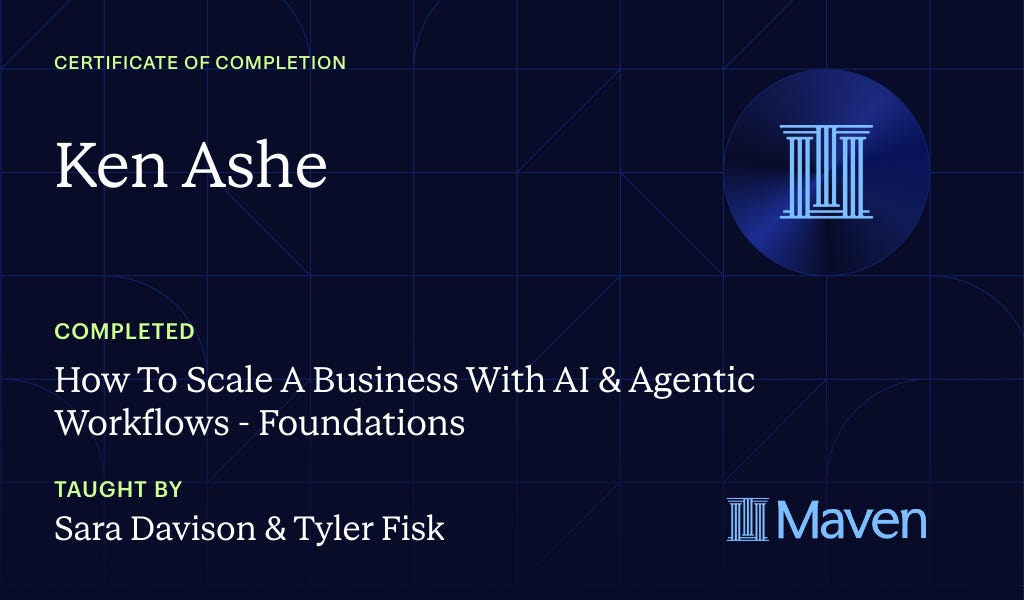
So far, I’ve completed two Maven certifications:
AI Prototyping for Product Managers
How to Scale a Business With Agentic Workflows (by AI Build Lab)
And I’m currently in the middle of:
Course: OpenClaw & Claude Code Certification for AI-Native PMs (by AI Product Academy, taught by Dmitry Shapiro and Dr. Marily Nika)
Book: AI Engineering by Chip Huyen
Honestly, it’s this third class that pushed me from “I should really do this” to “I’m doing this now.” The combination of OpenClaw and Claude Code is opening my eyes to what’s possible when you can actually design, build, and ship AI agents without being a traditional engineer. I want to spend serious time exploring it.
What’s next
I’ll be posting regularly here as the sprint unfolds. I’ll also be sharing progress on LinkedIn and X along the way.